“A con-job”: Why Trump is pushing fossil fuels at the world’s expense
CHRISTOPH NEDOPIL | 10 MINUTE READ
Introduction
Since the post-inauguration flurry of activity, exemplified by “Liberation Day” on April 2, 2025, the Trump administration has aggressively used energy exports as a mandatory feature of global trade negotiations. Steadfast US allies, including Japan and the European Union, were quickly forced to the table, linking defence assurances and trade access to agreements for buying US energy.
The terms are dramatic: The EU has reportedly committed to importing up to USD750 billion of US energy—predominantly Liquefied Natural Gas (LNG)—by 2028 (as a reference: the EU already imports 14.2 per cent of its oil, 57.7 per cent of its LNG, and 35.3 per cent of its coal from teh US which just adds to a total value of USD 15 billion in Q2 2025)[1]. Japan agreed to explore major new LNG offtake deals[2]. The US inclusion of energy exports in trade negotiations also expanded to former “clean energy transition partners” of the USA, such as Indonesia, which agreed to USD15.4 billion in energy imports[3].
Why is Trump pushing fossil fuels at this cost to everyone else? The reasons are a direct application of a simple “America First” doctrine built on securing the long-term profitability and geopolitical power of US industries.
Three reasons for the fossil fuel push
The administration’s energy policy is driven by a combination of business preservation, geopolitical leverage, and strategic competition with China.
1. America First for fossil fuel businesses
The US is the number one producer of oil and gas globally: US firms control 19.1 per cent of global oil and 25.5 per cent of global gas production—significantly more than Russia (11.7 per cent of global oil, and 15.5 per cent of global gas production) or Saudi Arabia (11.4 per cent of global oil production) (see Figure 1). At current rates of exploitation, the USA has petroleum reserves for another 200 years.[4] Ensuring that global partners buy US oil thus secures the long-term profitability of US fossil fuel companies.
Figure 1: Global oil (left) and gas (production) by country (2015-2024)
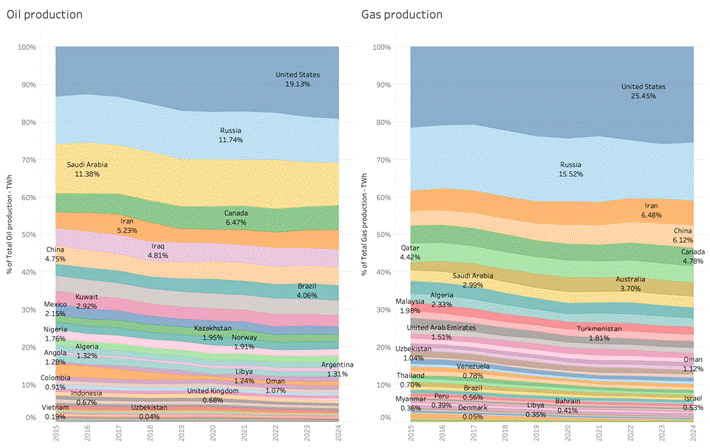
Source: Energy Institute. [5]
Industry projections, such as those from the International Energy Agency (until 2024), have shown that global oil and gas demand is expected to begin to decline[6]. This outlook clashes directly with the business model of major US producers, which rely on guaranteed, long-term revenue.
For these companies, every newly mandated gas-fired power plant in Europe, Japan, or Indonesia represents a guaranteed customer for 30–40 years. Trump’s trade policy essentially converts a risky, declining commodity market into a stable, decades-long “subscription model”, securing massive future revenue for American energy executives.
2. America First geopolitics: Preserving “energy leverage”
Historically, US global power has been built on providing “energy security”—guaranteeing a stable fossil fuel supply through the physical protection of sea lanes (like the Strait of Hormuz) and controlling the financial systems used to settle oil trades (petrodollar dominance). For example, many Middle Eastern oil fields are either owned by, or are selling directly to, US-owned companies and thus benefit from these security guarantees to sell oil globally. This control has given the US outsized geopolitical influence, allowing it to easily disrupt rivals by sanctioning their energy sales, as seen recently with Iran and Russia.
A global shift to decentralised renewable energy fundamentally weakens this US leverage (and the perceived domestic energy security in the US itself[7]). Conservative policy analysts have explicitly warned that if US allies rely on non-US-controlled energy, “the United States does not control [the energy flows] and we can’t intercept [energy flows].” [8] The current policy is therefore a deliberate attempt to dramatically increase U.S. capacity to influence global energy markets by making allies dependent on US fossil fuel supplies, thereby safeguarding a critical source of US geopolitical power. [9]
3. The anti-China logic: Blocking the renewable pivot
China has achieved a formidable dominance in the clean energy economy, controlling more than 80 per cent of the global supply chains for solar, wind, and batteries, with seemingly rapidly decreasing opportunities for technological catch-up by Western competitors[10]. This dominance is driven by massive domestic investment (e.g., China installed 212 GW of solar in the first half of 2025[11] and plans to double its battery storage to 180GW by 2027[12]) and surging global exports of green technology,[13] making up about 5 per cent of China’s exports[14] (see Figure 2).
Figure 2: Clean energy manufacturing capacity as share of global total by location, 2024
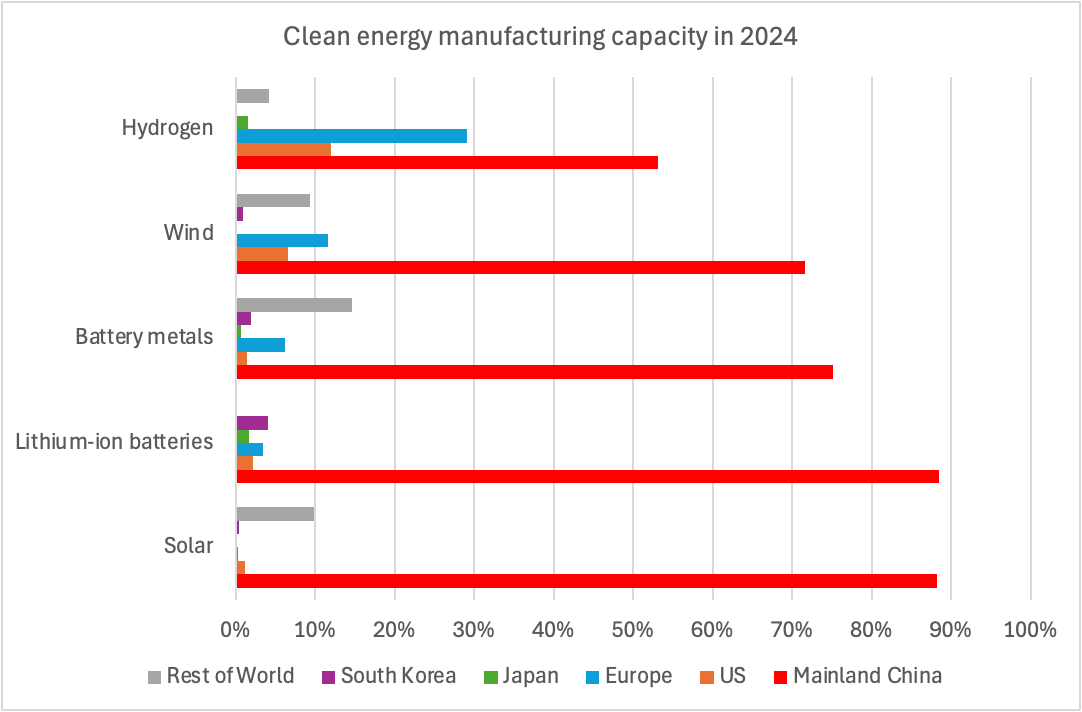
As green energy becomes cheaper than fossil fuels, China is positioned to be the main winner as the world’s chief supplier of the necessary technology.
The US conservative strategy to counter this is simple: reject the need for and opportunity of the transition entirely: “America is well endowed with natural resources and should reject plans to transition to ‘green energy’ technologies dominated by China”, according to the Heritage Foundation. To further stop other countries from using Chinese technology, it is envisaged that “the US should continuously highlight China’s abhorrent use of forced labour in the energy-technology sector, […], and find innovative ways to highlight China’s poor environmental stewardship.”[16]
In other words, by forcing allies to purchase US fossil fuels, discrediting renewables and China’s environmental and labour standards, the administration seeks to freeze the energy transition and prevent China from acquiring a new, powerful source of future economic and political leverage.
The cost to Asia and Australia
For US allies with significant fossil fuel export sectors, like Australia and Indonesia (fossil fuels make up to 25% of Australia’s exports), the push for US fossil fuels seems to offer an opportunity to keep fossil fuel exports alive as well. Accordingly, some in the local fossil fuel sector publicly call for Trump style leadership in their countries (for example, Gina Rinehart, an Australian owner of significant mining assets, provides such statements on her company’s website)[17]. Their hope is that a US-led expansion of fossil fuel use will extend economic lifelines of their assets against the previous global consensus of phasing down the use of fossil fuels to fight climate change.
However, this calculation might not add up for a simple reason: without a significant increase in global demand, increased US gas exports might come at the expense rather than the benefit of other exporters. Moreover, pursuing a US-dependent and fossil fuel-intensive energy path has severe negative risks for all economies:
1. Economic competitiveness
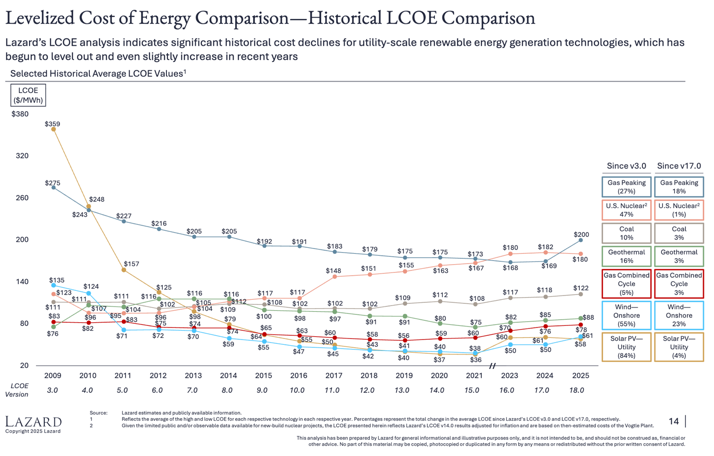
The first central issue is cost: Electricity generated by solar and wind has been the cheapest source of new energy for years, outcompeting all fossil fuels since around 2016 (see Figure 3). With battery prices falling, combined generation and storage solutions—which overcome renewables’ intermittency issues—have also become economically competitive. On the other hand, expanding the use of fossil fuel by expanding fossil fuel infrastructure meanwhile risks being both more expensive for consumers and industries and exposes countries to continuous price volatility of global fossil fuels (e.g., recent energy price increases were driven by gas price volatility after Russia invaded Ukraine). Consequently, economies that rely on fossil fuels rather than green energy risk having higher and less stable electricity costs compared to those using cheaper renewable power. Overall, such a higher energy cost risks long-term erosion of industrial and economic competitiveness.
Figure 3: Levelised cost of energy (LCOE) comparison since 2009
2. Energy dependence
The second issue is that a deepened dependence on any single supplier of energy (such as the US) reduces energy security. This is the opposite of what nations should be optimising for.
3. Climate cost
The third issue, and possibly the most universally shared issue, is the risk of increased climate damage through the continued (and expanded) use of fossil fuels and consequent greenhouse gas emissions (burning of fossil fuels for energy contributes to about 75 per cent of global emissions). For nations highly exposed to climate change, like Australia, the impacts are direct and economically and socially dramatic. Australia’s National Climate Risk Assessment, published in September 2025, projects that climate-related insured losses could increase from A$4.5 billion to an annual A$40.9 billion by 2050[18]—a cost similar to the total value of current Australian gas exports or three times the export value to the US[19].
How to turn this con-job into an opportunity for Australasia?
When Trump called climate change “a con job” during his speech to the United Nations General Assembly September, 2025 (a con job is typically understood as a dishonest plan to deceive someone, often with the intent to gain money[20]), it might be worth considering who is trying to con who and how to avoid being on the losing end.
Asian economies and Australia, instead of being pressured into an America First economy, should rather accelerate their green energy opportunities. In the medium-term, this would bring lower energy prices, and more importantly, they would reap the possibly much more significant benefits from participating in the dynamic green energy economy. Research and evidence over the past five years has already shown how businesses and communities (in addition to climate) in Australia, Indonesia and many other economies benefit from a more ambitious green transition through innovation and new jobs.[21]
This can include economic opportunities in the following four areas:
Opportunity 1
Establish integrated Australia–ASEAN critical mineral-to-battery supply chains
The region should establish integrated critical mineral to battery supply chains, where Australia and Indonesia (and some others) provide critical minerals (e.g., lithium, nickel, cobalt), which can be processed and manufactured to batteries in ASEAN economies, as well as China and India. This will strengthen stable, secure, and ethical raw materials and production supply chains relevant for the electric car and battery manufacturing industry.
Opportunity 2
Develop regional green hydrogen and ammonia supply chains through collaboration
The region should develop regional green hydrogen and ammonia supply chains. This spans from the production of green hydrogen and ammonia to energy storage/transport for electricity and to industrial use of hydrogen (e.g., for low-carbon steel production). Australia can use its significant solar and wind sources to generate green hydrogen with significant parts of technology provided by Japan, Korea, China and others. Long-term off-take agreements (e.g., between Japan, Korea, China and Australia) can reduce risks of necessary investments.
Opportunity 3
Establish integrated electricity grids
The region should accelerate regional electricity grid integration to allow economies to trade not only in energy, but in electricity across borders. This will allow industries to access cheaper electricity, address intermittency, while also ensuring mutual dependence for energy to reduce single country dependencies. Initial steps have been taken already by ASEAN and Laos has started to export electricity to Vietnam in September 2025 from the USD 950 million 600 MW Monsoon Wind Power project – the first cross-border renewable energy project in Asia.[22] Expanding grids requires significant policy support as well as investment guarantees (while the investment itself is likely bankable).
Opportunity 4
Build green, trusted data processing based on green energy
Finally, energy-intensive data centres and AI computing facilities should be built to spur further investment in green energy and allow the region to form a green, trusted data network (with willing and relevant countries).
Conclusion
In summary, US businesses and political hawks would be the biggest winner of a stalled green energy transition and deepening of fossil fuel economies. At the same time, Trump’s intentions in this game are too obvious for any serious nation to believe that the greatest showman who calls climate change a con-job is not trying to deflect from his trick and threat: “I’m telling you that if you don’t get away from the green energy scam, your country is going to fail”[23]. In the end, the result might just be the opposite.
Australia, in particular, could lead the way based on its good governance and access to green energy.[24]
About the author

Dr Christoph NEDOPIL is the Director of the Griffith Asia Institute and a Professor at Griffith University in Brisbane, Australia. He is also a Visiting Professor at FISF Fudan University, Shanghai, Acting Director of the Green Finance & Development Center at FISF Fudan University, and a Visiting Faculty at Singapore Management University (SMU).
Christoph regularly provides advice to governments, financial institutions, enterprises, and civil society on sustainable development issues. He is the lead author of the UNDP SDG Finance Taxonomy, the Innovative Climate Finance Solutions report for the G20 in Indonesia, and the Green Development Guidance of the BRI Green Development Coalition under the Chinese Ministry of Ecology and Environment. He has authored four books and published articles in Science and other leading journals. Christoph serves as a board director in scaling sustainability in businesses and finance.
Christoph is quoted regularly in Financial Times, The Economist, Reuters, Bloomberg, and other major outlets. Before joining Griffith University, he served as Founding Director of the Green Finance & Development Center and Associate Professor at the Fanhai International School of Finance (FISF), Fudan University and previously as Founding Director for the Green BRI Center at the Central University of Economics in Beijing. He worked with the World Bank in over 15 countries and was a Director in the German development agency GIZ. Christoph holds a Master of Engineering and a PhD in Econom
Notes and references
[1] Eurostat. (2025, December). EU imports of energy products—Latest developments. Eurostat. https://ec.europa.eu/eurostat/statistics-explained/index.php?title=EU_imports_of_energy_products_-_latest_developments
[2] The White House. (2025, July 23). Fact Sheet: President Donald J. Trump Secures Unprecedented U.S.–Japan Strategic Trade and Investment Agreement. The White House. https://www.whitehouse.gov/fact-sheets/2025/07/fact-sheet-president-donald-j-trump-secures-unprecedented-u-s-japan-strategic-trade-and-investment-agreement/
[3] Gokce, S. (2025, July 3). Indonesia offers US $34B goods deal, including LNG, amid tariff talks. Energy Terminal. https://www.aa.com.tr/en/energy/general/indonesia-offers-us-34b-goods-deal-including-lng-amid-tariff-talks/50308
[4] Wile, R. (2012, March 20). The US Is Sitting On A 200-Year Supply Of Oil. Business Insider. https://www.businessinsider.com/us-200-year-supply-oil-2012-3
[5] Energy Institute – Statistical Review of World Energy (2025) – with major processing by Our World in Data, https://ourworldindata.org/grapher/fossil-fuel-production
[6] IEA. (2024). Executive Summary – World Energy Outlook 2024 – Analysis. IEA. https://www.iea.org/reports/world-energy-outlook-2024/executive-summary
[7] Gross, S., & Sall, L. (2025, January 13). How do China and America think about the energy transition? Brookings. https://www.brookings.edu/articles/how-do-china-and-america-think-about-the-energy-transition/
[8] Carafano, J., Pillsbury, M., Smith, J., & Harding, A. (2023, March 28). Winning the New Cold War: A Plan for Countering China. The Heritage Foundation. https://www.heritage.org/china/report/winning-the-new-cold-war-plan-countering-china
[9] Carafano, J., Pillsbury, M., Smith, J., & Harding, A. (2023, March 28). Winning the New Cold War: A Plan for Countering China. The Heritage Foundation. https://www.heritage.org/china/report/winning-the-new-cold-war-plan-countering-china
[10] Marsh, A. (2025, September 21). China Road Trip Exposes List of Uninvestable Assets in the West. Bloomberg.Com. https://www.bloomberg.com/news/articles/2025-09-21/china-road-trip-exposes-list-of-uninvestable-assets-in-the-west
[11] Yang, M., Yang, B., Butler-Sloss, S., Graham, E., Shi, X., & Black, R. (2025). China Energy Transition Review 2025. Ember. https://ember-energy.org/latest-insights/china-energy-transition-review-2025
[12] China aims to nearly double battery storage by 2027 in $35 billion plan. (2025, September 12). Reuters. https://www.reuters.com/sustainability/boards-policy-regulation/china-aims-nearly-double-battery-storage-by-2027-35-billion-plan-2025-09-12/
[13] Myllyvirta, L. (2025, September). China energy exports. https://www.linkedin.com/posts/lauri-myllyvirta-3164703b_breaking-the-value-of-chinas-exports-of-activity-7370693371905851392-tzt9/
[14] Zhang, J., & Nedopil, C. (2024). China Green Trade Report 2023. Griffith Asia Institute. doi.10.25904/1912/5221 https://blogs.griffith.edu.au/asiainsights/china-green-trade-report-2023/
[15] Marsh, A. (2025, September 21). China Road Trip Exposes List of Uninvestable Assets in the West. Bloomberg.Com. https://www.bloomberg.com/news/articles/2025-09-21/china-road-trip-exposes-list-of-uninvestable-assets-in-the-west
[16] Carafano, J., Pillsbury, M., Smith, J., & Harding, A. (2023, March 28). Winning the New Cold War: A Plan for Countering China. The Heritage Foundation. https://www.heritage.org/china/report/winning-the-new-cold-war-plan-countering-china
[17] Vietokhina, S. (2025, May 2). Australia’s richest person Gina Rinehart says she wants Trump-like reforms as election nears. Hancock Prospecting PTY LTD. https://www.hancockprospecting.com.au/australias-richest-person-gina-rinehart-says-she-wants-trump-like-reforms-as-election-nears/
[18] Australia Climate Service. (2025, September). NCRA Climate risks. https://www.acs.gov.au/pages/ncra-climate-risks
[19] Harvard Growth Lab. (2025). The Atlas of Economic Complexity. https://atlas.hks.harvard.edu/explore/treemap?exporter=country-36&view=markets
[20] CON JOB definition and meaning | Collins English Dictionary. (n.d.). Collin. Retrieved October 6, 2025, from https://www.collinsdictionary.com/dictionary/english/con-job
[21] Australia to gain $370 billion with a 75% target. (2025, August 26). Fortescue. https://fortescue.com/en/articles/; CSIRO. (2024). Towards net zero. CSIRO. https://www.csiro.au/en/about/challenges-missions/Towards-net-zero; International Labour Organization (ILO). (2024, January 28). Green jobs in Asia and the Pacific. https://www.ilo.org/regions-and-countries/asia-and-pacific/green-jobs-asia-and-pacific; Nedopil, C., & Zhang, J. (2024). Future made in Australia? Evaluating Australia’s 2024 green energy related policies and its potential impact on Asia. Griffith University. https://doi.org/10.25904/CETE-QZ51
[22] Tribdino, R. (2025, September). Laos Wind Farm Begins Power Exports to Vietnam in Regional First. Cleantechnica. https://cleantechnica.com/2025/09/07/laos-wind-farm-begins-power-exports-to-vietnam-in-regional-first/
[23] Volcovici, V. (2025, September 24). Trump tells UN that climate change is “greatest con job” globally. Reuters. https://www.reuters.com/sustainability/cop/trump-tells-un-that-climate-change-is-con-job-2025-09-23/
[24] Dong, J., & Nedopil, C. (2025, September 24). AI “processed in Australia”: A vision for Australia’s leadership in trusted data exports . Griffith Asia Insights. https://blogs.griffith.edu.au/asiainsights/ai-processed-in-australia-a-vision-for-australias-leadership-in-trusted-data-exports/