Solomon Islands’ Automated Transfer System (SOLATS): Financing in the future
Country: Solomon Islands
Date range: 2019 – Present
Key institutions: Central Bank of Solomon Islands (CBSI), International Finance Corporation (IFC) World Bank Group, Montran Corporation, Datec, and the United Nations (UN) Capital Development Fund
Introduction
The Solomon Islands is a picturesque island chain that lies to the northeast of Australia. However, its natural beauty masks a troubling reality. The Solomon Islands is considered one of the least developed countries and most isolated economies in the world[i], with a digital economy score (DES) of only 39 per cent (see Figure 2) and comparatively low levels of financial inclusion (see Figure 1).
Figure 1: Financial Inclusion Index (FII Index) 2004-2022
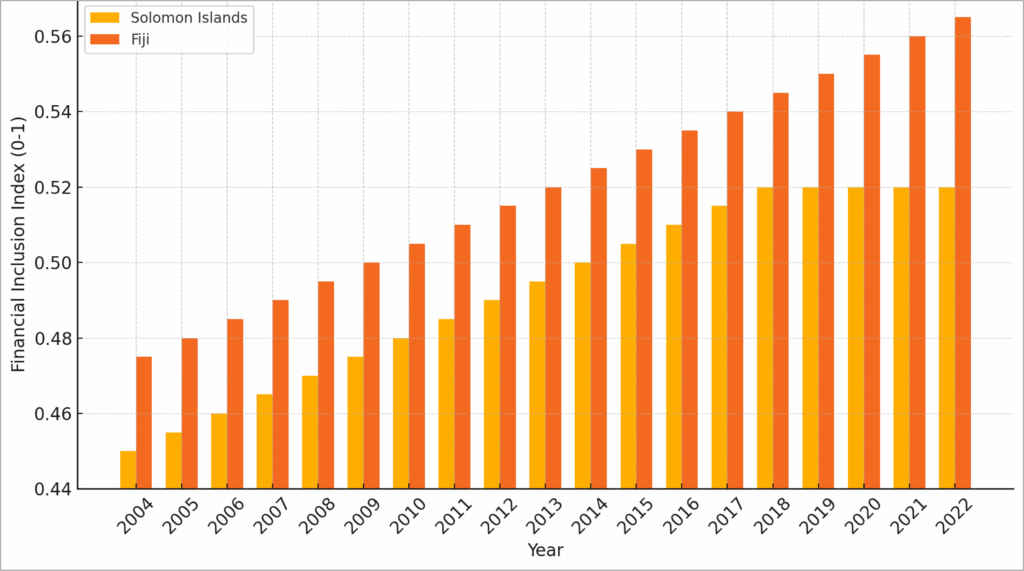
Four major categories factor into the effectiveness—or lack thereof—of the country’s digital payment architecture: financial infrastructure, telecom infrastructure, regulatory framework, and user readiness.[ii] In terms of financial infrastructure, geographic dispersion significantly disrupts access to banking facilities or ATMs, with approximately 70 per cent of banks and 83 per cent of ATMs located in the capital city, Honiara, excluding many who live in rural areas. Interbank transfers also face significant delays as manual cheques remain the norm.[iii] The island chain has also been heavily reliant on cash, which accounted for more than 80 per cent of all transactions in 2020, with limited smartphone access contributing to the inaccessibility of mobile money wallets for consumers.[iv]
Telecom infrastructure may seem like a separate area entirely, but in the case of the Solomons, it is deeply embedded within the digital payment infrastructure. In 2020, internet access was available to less than 28 per cent of the population[v], with even less access to 4G coverage. In terms of the current regulatory framework, insufficient cybersecurity measures and money laundering risks hinder the maturity of digital payments, with criminals exploiting the system. While the Solomon Islands scored relatively high in digital literacy compared to its peers (see Figure 1), it remains well behind neighbouring countries and the broader global context. As of 2020, 22 per cent of women were financially excluded from participating in the digital economy, highlighting issues of inclusion under the previous model.[vi]
Figure 2: Inclusive digital economy scorecard highlights

United Nations Capital Development Fund (UNCDF)[vii]; United Nations Development Programme (UNDP).[viii]
Intervention
Fortunately, the government recognised the predicament and has taken active steps to enhance its digital payment infrastructure, as part of broader efforts to strengthen its digital backbone. The National E-Commerce Strategy, developed in 2022, laid the foundation by creating a roadmap for national access to electronic markets over the coming decade. It followed the 2016 National Development Strategy, which aims to improve the social and economic livelihoods of all Pacific Islanders.[ix]
Additionally, the Solomon Islands has pursued digital inclusion through a series of National Financial Inclusion Strategies, with the third edition published in 2021. These strategies aim to bridge gaps in access due to factors such as gender, location, and age.[x] A critical legislative milestone was the Payment Systems Act 2022, which corrected outdated digital payment regulations and mandated the Central Bank of Solomon Islands (CBSI) to oversee these initiatives.[xi] One major development under this law was SOLATS.
Conceptualised as early as 2019 and officially rolled out in 2024, SOLATS (Solomon Islands Automated Transfer System) is a real-time gross settlement (RTGS) payment system. It enables immediate payment transfers between banks and customers, replacing slow, manual cheque transactions and supporting the nation’s broader digital roadmap. The system integrates with other digital economy initiatives and promotes inclusiveness for all islanders.[xii]
Lessons Learned
COVID-19 functioned paradoxically as both disruptor and accelerator for SOLATS implementation—delaying reforms due to travel restrictions but also exposing vulnerabilities in cash-based systems. Ultimately, this strengthened institutional commitment to digital transformation.[xiii] Despite these challenges, a multi-stakeholder governance approach drove the project forward. CBSI coordinated regulatory oversight while international partners—including the World Bank Group’s IFC with Australian and New Zealand funding—contributed technical expertise. Montran Corporation and Datec supported implementation by aligning global standards with local realities.[xiv]
As implementation progressed, cultural adaptation emerged as a key challenge when the standardised interface failed to resonate with local users. In response, implementers introduced visual cues, local languages, and culturally relevant user flows.[xv] Infrastructure limitations also posed barriers—approximately 80 per cent of Solomon Islanders lack electricity access[xvi], and even where infrastructure exists, power unreliability and high costs continue to hinder adoption. These challenges highlighted the need for holistic planning.
The early establishment of the National Payment Systems Act provided legal certainty but also demonstrated the importance of adaptive regulation as deployment progressed.[xvii]
Impact
Despite these barriers, SOLATS represents a watershed moment in the Solomon Islands’ digital development. Its 2024 deployment has disrupted traditional banking, reducing interbank transfer times from two to three days to around 10 minutes.[xviii] As Governor Forau noted, the platform has “revolutionised payments in Solomon Islands” by enabling faster, safer, and more efficient transactions.[xix]

SOLATS directly addresses logistical issues in a geographically dispersed country. Previously, about 15,000 cheques worth approximately SBD 93 million were processed monthly.[xx] Now, instant settlements are possible in provincial centres such as Auki and Gizo, improving liquidity, reducing delays, and lowering transaction costs for rural populations.
The system’s impact has been tangible and immediate. For example, small business owners in Honiara who previously waited days for supplier payments now complete transactions within minutes, enhancing cash flow and reducing reliance on costly working capital.[xxi] Civil servants in remote areas receive salaries promptly, aligning with goals in the National Financial Inclusion Strategy 2021–2025.[xxii] Automation reduces costs for individuals and businesses alike, creating greater efficiencies.
Digital trust has strengthened due to enhanced security features, including multifactor authentication and end-to-end encryption. CBSI monitoring reports that payment errors and customer complaints have significantly decreased since implementation[xxiii], accompanied by a three per cent DES increase in 2022.[xxiv]
The transformation has also enhanced institutional capacity. CBSI and commercial banks received technical training in system operation, enabling the launch of additional initiatives such as a Central Securities Depository and future Automated Clearing House services.[xxv]
The National Payment System Act 2022 not only offered legal legitimacy to SOLATS but also allowed for flexible implementation.[xxvi] By adhering to technical compatibility standards, SOLATS is poised for future integration with regional RTGS systems such as FIJICLEAR and Papua New Guinea’s Kina Automated Transfer System. This will enhance cross-border payment interoperability and reduce remittance costs throughout the Pacific[xxvii], a region already experiencing declining correspondent banking relationships (see Figure 2).
Figure 3. Pacific Island Countries: Inward Remittances and Number of Active Correspondent Banking Relationships
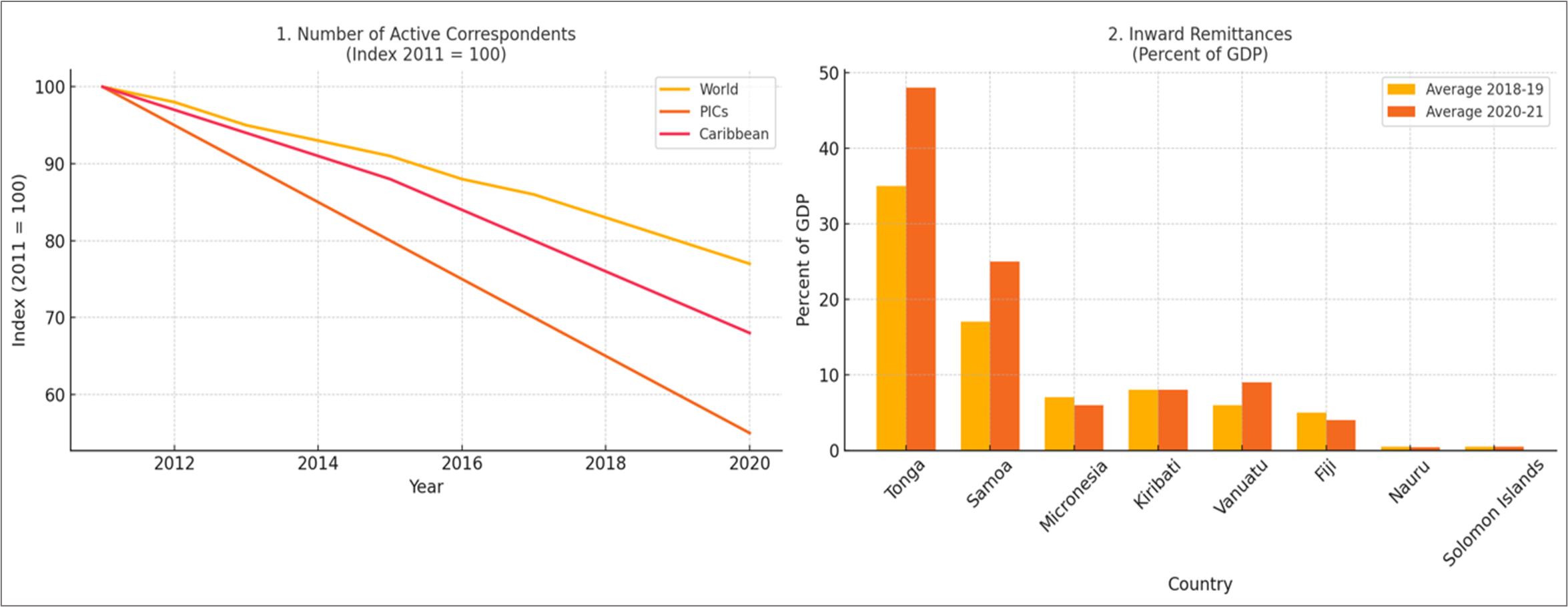
Note. Adapted from Rise of Digital Money: Implications for Pacific Island Countries (p. 21), by Y. S. Zhou, T. Sun, A. Paduraru, A. Bharath, S. Forte, K. Kao, Y. Lu, M. F. Chacon Rey, P. Sodsriwiboon, C. Y. Tan, & B. Zhao, 2024, International Monetary Fund. (https://www.imf.org/-/media/Files/Publications/DP/2024/English/RDMEA.ashx). Data from Bank for International Settlements, IMF World Economic Outlook database, IMF staff calculations, and IMF staff estimates. PICs = Pacific island countries.
Recommendations
The Solomon Islands has made commendable progress in digital development. SOLATS is a key part of this effort. Though still in its early stages, the results are promising. The following recommendations are proposed:
- Promote interoperability across digital payment systems.
Currently, users must navigate multiple applications with limited knowledge and access. This increases the risk of users reverting to cash. Strong collaboration between government and stakeholders is needed to ensure legal, structural, and commercial frameworks meet international standards.[xxviii] The CBSI should lead this effort, collaborating with Pacific nations such as Samoa that have tackled similar issues. - Strengthen digital infrastructure.
SOLATS is a foundation, but broader integration is needed, including national ID and postal systems, which would improve fraud prevention and accessibility for rural populations.[xxix] The government should engage with local businesses and banks to co-design practical, trusted solutions. - Adopt a proactive regulatory environment.
Several gaps remain in cybersecurity, data protection, and bank oversight. The government must take a more active role, borrowing best practices from neighbouring nations and international bodies like the UN. Integrating sustainability and inclusion principles from the Sustainable Development Goals will also be vital in addressing gender and equity challenges.[xxx]
Conclusion
The Solomon Islands still lags behind many developing countries in areas such as digital literacy, internet access, and gender and rural equity. But efforts like SOLATS demonstrate the country’s determination to close these gaps and join the broader Pacific in digital advancement. Although still in its infancy, SOLATS represents a meaningful shift toward financial inclusion and payment modernisation. With support from global partners and a collaborative local approach, the Solomon Islands can build on this foundation and ensure that all islanders share in the benefits of digital transformation.[xxxi]
Additional resources
- Pacific E-commerce Initiative https://pacificecommerce.org/pei-project/solomon-islands-national-payment-system/
- Pan Oceanic Bank https://pob.com.sb/service/internet-banking/
- Solomon Business Magazine https://sbm.sb/25689-2/
- World Bank Group https://www.ifc.org/en/pressroom/2022/ solomon-islands-reforms-making-banking-easier-and-increasing-access-to-affordable-digital-services
This case study was authored by Jarrett Apicella and Gayle Ventura
[i] United Nations Trade & Development (UNCTAD). (n.d.). UN list of least developed countries. https://unctad.org/topic/least-developed-countries/list
[ii] Central Bank of the Solomon Islands (CBSI). (2023). Assessment of the Retail Payments Ecosystem in the Solomon Islands. CBSI. https://www.cbsi.com.sb/wp-content/uploads/2023/10/Assessment-of-Retail-Payment-System-_-FINAL.pdf
[iii] Ibid
[iv] Coupienne, F., Kleiman, P., Peters, B., & Shah, S. (2021). Inclusive Digital Economy Scorecard Report: Solomon Islands 2020. United Nations Capitol Development Fund. https://www.mca.gov.sb/resources/publications/strategic-plans/115-the-inclusive-digital-economy-scorecard-in-solomon-islands/file.html
[v] Kemp, S. (2021, February 12). Digital 2021: The Solomon Islands. Datareportal. https://datareportal.com/reports/digital-2021-solomon-islands#:~:text=The%20number%20of%20internet%20users%20in%20the%20Solomon,Solomon%20Islands%20stood%20at%2028.6%25%20in%20January%202021
[vi] Coupienne, Kleiman, Peters & Shah (2021).
[vii] UNCDF. (2021). INCLUSIVE DIGITAL ECONOMY SCORECARD REPORT: SOLOMON ISLANDS 2020. UNCDF. https://www.uncdf.org/article/6714/inclusive-digital-economy-scorecard-report-solomon-islands
[viii] United Nations Development Programme (UNDP). (n.d.). An Inclusive Digital Economy Can Accelerate Development and Growth in Solomon Islands. https://www.undp.org/pacific/inclusive-digital-economy-can-accelerate-development-and-growth-solomon-islands#:~:text=With%20a%20digital%20economy%20score%20of%2039%20percent%2C,regards%20to%20the%20development%20of%20the%20digital%20economy
[ix] Ministry of Communication and Aviation (MCA). (2022). National E-commerce Strategy: 2022-2027. Solomon Islands Government. https://www.mca.gov.sb/resources/publications/strategic-plans/156-solomon-islands-national-e-commerce-strategy-2022-2027/file.html
[x] CBSI. (2021). Solomon Islands National Financial Inclusion Strategy 3 (2021-2025). CBSI. https://www.cbsi.com.sb/wp-content/uploads/2021/04/Solomon-Islands-National-Financial-Inclusion-Strategy3-1.pdf
[xi] Solomon Islands Government. (2022). Payment Systems Act 2022 (No. 2). CBSI. https://www.cbsi.com.sb/wp-content/uploads/2023/04/Payment-Systems-Act-2022.pdf
[xii] CBSI. (2024, April 16). Luke Forau: Launch of Solomon Islands’ payment system SOLATS. Bank for International Settlements. https://www.bis.org/review/r240416j.htm
[xiii] World Bank, The. (2022). Strengthening financial stability, resilience and safety nets in the Pacific Islands: Compilation of in-depth papers. International Bank for Reconstruction and Development / The World Bank. http://documents1.worldbank.org/curated/en/099011502062388343/pdf/P17493305132130540bf5e024338cf26d6b.pdf
[xiv] Gagahe, N. (2024, April 10). Governor Forau hails IFC, WBG and donor partners. The Island Sun. https://theislandsun.com.sb/governor-forau-hails-ifc-wbg-and-donor-partners/
[xv] United Nations Capital Development Fund (UNCDF). (2023, October 30).
Assessing digital and financial literacy in Solomon Islands: Survey on knowledge, skills and access. UNCDF.
https://www.uncdf.org/Download/AdminFileWithFilename?id=19777&cultureId=127&filename=assessing-digital-and-financial-literacy-in-solomon-islandspdf
[xvi] University of Texas. (2019, November 24). Electrification in Oceania: Case study of the Solomon Islands. Climate Security in Oceania. https://sites.utexas.edu/climatesecurity/2019/11/24/electrification-in-oceania-case-study-of-the-solomon-islands/
[xvii] World Bank, The. (2021). Accelerating practical digital development in the Solomon Islands (AUS0002066). World Bank Group. https://hdl.handle.net/10986/35319
[xviii] CBSI. (2022, December 5). CBSI Automated Transfer System (ATS) implementation training underway [Press Release]. CBSI. https://www.cbsi.com.sb/joint-press-release-212022-cbsi-automated-transfer-system-ats-implementation-training-underway/
[xix] CBSI. (2024). Solomon Islands New Payment System to Improve efficiency and increase access to Banking, Support Economy [Press Release]. CBSI. https://www.cbsi.com.sb/press-release-06-24-solomon-islands-new-payment-system-to-improve-efficiency-in-payment-and-increase-access-to-banking-support-economypress-release-06-24/
[xx] CBSI (2023).
[xxi] Solomon Islands Government. (2025, April 11). Solomon Islands has potential to leap in digital transformation. https://solomons.gov.sb/solomon-islands-has-potential-to-leap-in-digital-transformation/
[xxii] UNCDF (2023).
[xxiii] CBSI (2022).
[xxiv] Coupienne, F., & Tate, Z. V. (2024, 12 March). A digital transformation journey driven by data since 2020 in Solomon Islands. CBSI. https://www.cbsi.com.sb/wp-content/uploads/2024/04/Article-No.1.24-A-digital-Transformation-Journey-driven-by-data-since-2020-in-Solomon-Islands.pdf
[xxv] Montran. (2024, May 28). Montran’s ATS & CSD Solutions Deployed in the Solomon Islands. Montran News and Press. https://www.montran.com/resources/montrans-ats-csd-solutions-deployed-in-the-solomon-islands/
[xxvi] World Bank, The. (2021).
[xxvii] Pacific Islands Forum Secretariat. (2024). Solomon Islands National Payment System – Pacific E-commerce Initiative. https://pacificecommerce.org/pei-project/solomon-islands-national-payment-system/
[xxviii] CBSI. (2023). CBSI Annual Report 2023 – Chapter 4: Central Banking Operations. CBSI. https://www.cbsi.com.sb/wp-content/uploads/2024/04/CBSI-Annual-Report-2023-Final.pdf
[xxix] Ibid.
[xxx] Ibid.
[xxxi] Ministry of Women, Youth, Children, and Family Affairs (MWYCFA). (2018, December 5). Gender Equality & Women’s Development. Solomon Islands Government. http://mwycfa.gov.sb/what-we-do/gender-equality-women-s-development.html