China: Staying the course
CHRISTOPH NEDOPIL, JEAN DONG AND HUI FENG | 40-MINUTE READ |
Introduction
Western perceptions of China have become more negative, with the United States (US) engaging in an aggressive trade war with China. Meanwhile, China seems to have developed a more routine and calculated response to Western pressures and was—for the time being—able to stay its course of economic self-sufficiency and international engagement. This has led to some seeing China as having the upper hand in US-China trade negotiations[1] and as the major pillar for international green and sustainable development.[2]
China’s strength in 2025 and, as we analyse, moving forward builds on interlocking strategies in regional political engagement, technological advancements, green transition, trade and its domestic economy. China’s growing regional political clout was exhibited during the Shanghai Cooperation Organization (SCO) meeting in September 2025, bringing together 24 heads of state in Tianjin – including the first meeting of heads of state from India and Pakistan just weeks after their armed conflict. The ensuing World War II victory day parade brought all but eight Asian economies’ heads of state to Beijing. China also boosted its technological strength in areas such as artificial intelligence (AI), its dominance in green technologies and its credible progress in climate ambitions and used its effective control of various global supply chains, including in critical minerals with their relevance for both civil and military purposes, as an international pressure point. China continued to strengthen the internationalisation of its currency (renminbi – RMB), which worries the proponents of a US-dollar-dominated global economy, and it strengthened its exports. Meanwhile, its domestic economy continued the fight against deflation, weak consumption and a housing crisis – exhibiting certain policy consistency of not providing more government stimulus for short-term gains.
Our overall analysis suggests that China’s trajectory and policy positions have exhibited relative predictability and stability in its ambitions and “red lines”, particularly when compared to many short-term economic and policy adjustments seen in Western countries over the past months. We find that Western criticism of China’s development is increasingly seen as hypocritical, lacking moral high ground and economic advantages. Rather, China seems to have become more confident about its destiny as the world’s largest economy (by PPP) while having to chart its own course in a less trusting and more transactional geostrategic environment.
This leads us to our conclusion that in this world, we cannot overstate how important a nuanced understanding of China’s role in the region is, where we should neither overestimate nor underestimate China. We must avoid the often-irrational pendulum swings of embracing and distancing ourselves from China, which undermines trust and collaboration opportunities. We see significant opportunities for constructive engagement that address both joint interests and potential conflicts. With significant risks on the horizon, this nuanced strategy will determine whether the region will foster peace and prosperity or face rising tensions and instability.
China’s regional political clout through SCO, APEC, ASEAN, BRICS, BRI, and beyond
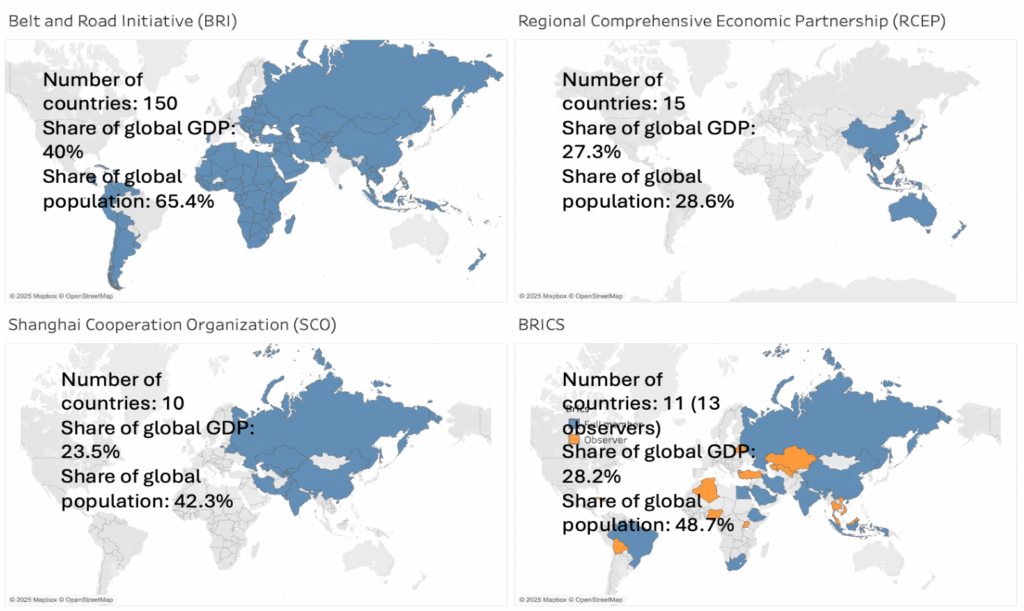
China’s regional engagement in 2025 centred on reinforcing multilateral political frameworks and promoting its governance concepts in the Asia-Pacific and the Global South based on several frameworks in which it has a leading position (see Figure 1).
The focal point of China’s diplomatic calendar was the hosting of the 25th SCO summit from August 31 to September 1. During the SCO meeting, 24 heads of state (including 14 heads of non-SCO member states such as Malaysia, Vietnam, and Laos), plus leading figures such as the UN Secretary-General, came to Tianjin. Major economic and developmental commitments included the announcement to establish an SCO development bank and China’s pledge to invest in 20 gigawatts (GW) of renewable energy (10 GW solar and 10 GW wind) across all SCO member countries over the next five years. Further announcements stressed AI cooperation, innovation, big data, and e-commerce, aimed at aligning digital standards and fostering R&D integration.[3] Xi Jinping also announced the fifth of his initiatives[4]—the Global Governance Initiative—which saw significant endorsement from emerging economies as a response to frustrations with established Western-led
institutions. The initiative focused on five core principles: sovereign equality, international rule of law, multilateralism, people-centred approach and real results.[5] The summit also yielded significant diplomatic breakthroughs, notably the meeting between President Xi and Indian Prime Minister Modi, marking Modi’s first visit to China in seven years. This engagement softened strained relations with a declaration that the nations would be “partners, not rivals.” Furthermore, the summit facilitated a meeting between the leaders of India and Pakistan, three months after aerial attacks between the two nations, demonstrating the SCO’s capacity as a conflict-management platform.
In October 2025, China’s focus shifted to ASEAN and APEC summits taking place back-to-back in Kuala Lumpur and Seoul. Premier Li attended the ASEAN summit, where China upgraded the China-ASEAN Free Trade Area (ACFTA), agreeing to expand cooperation into the digital and green economies.[6] This comes while the US reportedly stepped back on multilateral trade negotiations during the meetings in lieu of bilateral trade negotiations. The APEC summit featured a high-profile summit between Xi and Trump. Xi furthermore put forward a five-point proposal aimed at promoting universally beneficial and inclusive economic globalisation and building an Asia-Pacific community.[7] Concurrently, the China-backed Regional Comprehensive Economic Partnership, comprised of ASEAN states, Australia, Japan, New Zealand and South Korea, also held its first summit since 2020 and called for wider trade efforts and the faster addition of new members.[8]
Figure 1: Chinese-led and supported mini- and multilateral institutions
Meanwhile, China’s influence in shaping global governance was also evident within the expanded BRICS framework. January 2025 saw Indonesia officially join the bloc, alongside the official welcome of nine new BRICS partner countries, including nations from Eastern Europe (Belarus), Latin America (Bolivia, Cuba), and Southeast Asia (Malaysia, Thailand).[9] A significant output was the BRICS Leaders’ Statement on the Global Governance of Artificial Intelligence, released at the 17th Summit taking place in Brazil. The statement prioritised comprehensive governance principles focused on reducing risks while addressing the needs of the Global South.[10] It is notable that, in contrast to prior meetings, the BRICS meeting put little emphasis on advancing de-dollarisation or alternative payment systems, possibly in response to US pressure.
The Belt and Road Initiative (BRI) maintained its central role, featuring again prominently in the proposal for the 15th Five-Year Plan issued in October 2025.[11] Economically, the BRI experienced a record year of financial engagement, with over $120 billion committed through construction and investment contracts in the first half of 2025 alone.[12] Membership dynamics saw a minor shift, with Panama exiting the BRI under pressure from the Trump administration, while Colombia joined in May 2025, maintaining the country count (excluding China) at 149.[13] Unlike previous bi-annual convenings of the Belt and Road Forum, 2025 saw no such event (the last Forum was held in 2023).
Meanwhile, regional security considerations involving China remained acute. The Shangri-La Dialogue saw no Chinese defence minister for the first time in five years. In light of the presence of the US defence minister, this gap led to a perceived asymmetry in high-level defence diplomacy.1[14] Meanwhile, territorial claims in the South China Sea persisted as a point of disagreement with the Philippines, despite some progress toward a Memorandum of Understanding (MoU) on coast guard cooperation.[15] Relations with Japan became more complicated, with reinforced security pledges aligning Japan with the US under its new Prime Minister Takaichi, unravelling previous minor progress on visa rules and sustained territorial disputes.[16] Remarkably, Indonesia progressed negotiations for the acquisition of Chinese J-10 fighter jets,[17] signalling a potential diversification away from dominant Western defence suppliers (at the time of writing this, no final decision had been made).
WHAT WE EXPECT IN 2026
China’s policy and diplomatic engagement in the region will increasingly have to navigate intensifying geopolitical tensions, with Western allies led by the US pressing regional partners—such as Japan—to take clearer positions against Beijing. Should external pressure escalate, particularly in the South China Sea or around Taiwan, China is likely to adopt a more assertive defence posture. Rather than seeking to project itself as a peacemaker, Beijing may instead frame the US as the principal instigator of regional instability while portraying its own actions as defensive. To this end, China will leverage its growing political influence in Asia to encourage non-aligned or weakly aligned states, including India and ASEAN members, to maintain neutrality in the event of heightened conflict.
Technological advancements
China is converting its vast market scale, deep industrial base, and growing scientific capacity into sustained technological leadership. Central to this effort is the pursuit of technological sovereignty and turning key technologies, such as AI, quantum technology, humanoid, biomanufacturing, brain–computer interfaces, and 6G communications into new engines of growth.
China continues to champion a hybrid innovation model that simultaneously preserves the government’s strategic coordination capacity and aims to unleash the agility and creativity of private enterprises. In 2024, Chinese national R&D investment reached 3.6 trillion yuan ($506 billion), a 48 per cent increase since 2020.Public R&D funding in biotech exceeds ¥20 billion ($3 billion) annually, and domestic startups raised over $20.6 billion in 2024 alone.[18] Chinese entities now hold about 49 per cent of global synthetic biology patents and account for roughly 70 per cent of global bioreactor capacity.[19]
Similar trends can be found in the fusion energy sector. In 2024, the Chinese government launched an industrial consortium aiming for a first industrial prototype fusion reactor by 2035 and commercialisation by 2050.[20] The private sector is very active too. In 2025, Shanghai Energy Singularity built a record 21.7-tesla magnet, while Hanhai Fusion Energy achieved plasma ignition in its HHMAX-901 device.[21] It means China has successfully initiated the process where plasma becomes self-sustaining, which is a major technical milestone toward viable fusion energy.
In the quantum computing field, in March 2025, China launched a ¥1 trillion ($138B) state-backed “hard tech” fund to support startups in fields like quantum computing, while tech giants Alibaba and Baidu had also invested heavily in quantum research.[22] China’s biggest quantum leap came in March 2025 when its Zuchongzhi 3.0 computer solved a problem in seconds that would take a supercomputer over 6 billion years—making it 1 million times faster than Google’s best and setting a global benchmark.[23]
AI is still at the heart of China’s technology ambitions. The number of generative AI users in China has reached 515 million in 2025.[24] Bank of America estimates that by 2030, China will invest between 2 and 2.5 trillion yuan (about $278–347 billion) in AI.[25] About one-third of China’s AI spending is expected to go into non-IT infrastructure. Among these non-IT investments, electric power and energy account for 38 per cent, advanced manufacturing for 10 per cent, and finance for 12 per cent.[26] There is an increasing number of experts who believe that the next stage of the AI race won’t just be about chips—it will be about energy. NVIDIA CEO Jensen Huang has recently suggested that China could pull ahead in AI thanks to its strong power generation capacity, reliable electric grid, and well-developed renewable energy supply chain.[27]
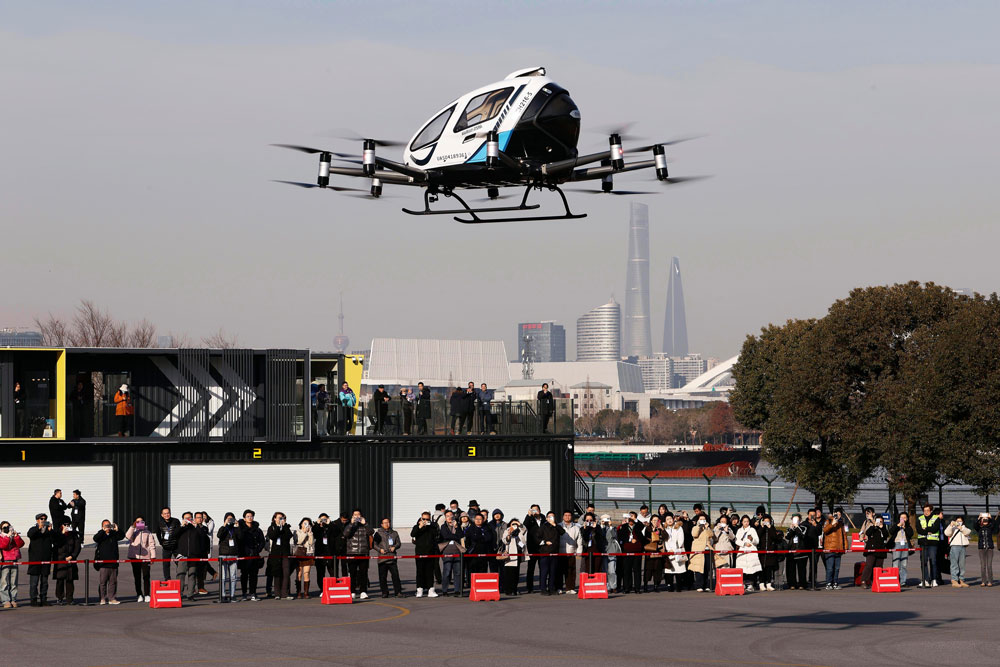
As we already mentioned in our last issue, an underappreciated frontier of innovation is China’s low-altitude economy, centred on electric vertical take-off and landing (eVTOL) vehicles—often dubbed “flying cars.” The sector’s relevance was reaffirmed in China’s 15th Five-Year Plan. According to the Civil Aviation Administration of China (CAAC), the low-altitude economy is projected to reach 1.5 trillion yuan (approximately $210 billion) by the end of 2025, with further growth to 3.5 trillion yuan (about $493 billion) by 2035.[28] Shenzhen is trialling its low-altitude airspace (planning 1,000 routes and 1,200 takeoff/landing sites by 2026) and offering a 15 million yuan (about $2.1 million) subsidy per certified passenger eVTOL. Guangdong province alone hosts over 15,000 companies involved in this sector.[29] In October 2025, Chinese company XPeng AeroHT announced 600-unit orders of its Land Aircraft Carrier from regional partners in the UAE, Qatar and Kuwait. Another leading company, EHang, reports over 7,000 global pre-orders and is lining up distributors in the Middle East, with plans to enter those markets by 2027.[30]
WHAT WE EXPECT IN 2026
The first year of China’s 15th Five-Year Plan marks an important shift from China pursuing technological catch-up to pursuing technological leadership: The Plan underscores technological self-reliance, industrial modernisation, and innovation in advanced sectors such as semiconductors, aerospace, quantum computing, and renewable energy, reflecting China’s ambition to lead global industry. As China becomes more technologically competitive, China–US technological competition in AI, in particular, will persist and likely intensify competition for critical minerals and energy resources. China will continue to strengthen collaboration with regional partners in technology application.
Green transition
2025 was a pivotal year for China’s green ambitions, marked by the country’s first reported absolute emission reductions[31] and a new level of ambition in its nationally determined contribution (NDC), which targets a 7 to 10 per cent decrease in economy-wide emissions by 2035.[32]
China’s green transition in 2025 was defined by three pillars: increased domestic policy and financial support, accelerated deployment of clean technologies, and a growing global leadership role. China’s green development must also be seen against international uncertainty and protectionist measures, with explicit policy reversals in the US, and to an extent in Australia, aiming to slow the global green transition to support incumbent local
Policy and finance
In September 2025, China released an updated NDC under the Paris Agreement, including, for the first time, a goal to cut economy-wide net greenhouse gas (GHG) emissions by 7-10 per cent from peak levels by 2035. This commitment to an absolute reduction target is a defining policy shift away from the previous intensity-based goals but lacks a base year in lieu of an undefined “peak year”. This shift also allowed the regulator to announce the transition of the national Emissions Trading System (ETS) from an often-criticised intensity-based control regime[33] to absolute emissions caps for stable sectors, slated to begin as early as 2027.[34]
The development of green finance was also a priority. The publication of the 2025 Green Finance Endorsed Project Catalogue unified previously fragmented standards, creating a single, clearer taxonomy that includes green trade and climate resilience.[35] This regulatory clarity helped green bond issuances reach a record high.[36] In a significant symbolic move in April 2025, China issued its first RMB-denominated sovereign green bond, signalling a commitment to setting green finance standards and cautiously advancing RMB internationalisation (see below).[37]
Clean energy deployment
China’s action in clean energy deployment continued its growth, serving as the primary factor driving down global technology costs. In the first half of 2025 (H1), China added 270 TWh of clean power generation (outpacing the 170 TWh growth in demand) by installing about 212 GW of solar and 51 GW of wind. This scale directly led to a two per cent drop in fossil fuel generation compared with H1 2024, resulting in a one per cent drop in overall CO2 emissions in H1 2025.[38] China also announced a plan to more than double its battery storage to 180 TWh by 2027.[39] This massive scale is also a result of rapid cost compression: the cost of key technologies, including wind, solar, and batteries, has fallen over the past few years, creating a competitive environment where clean energy is structurally cheaper than new fossil generation (albeit, cost declines in 2025 for solar modules seem to have stalled due to higher commodity prices).[40] China also expands production capacity of green energy technology above what the somewhat outdated International Energy Agency’s (IEA) Net Zero Roadmap[41] believes necessary: to limit global warming to 1.5°C, IEA calculates a need to add 761 GW of solar capacity per year in 2030. Already today, Chinese factories alone can theoretically supply that, and China’s projected solar manufacturing capacity in 2030 is 1,255 GW per year. Batteries tell a similar story: in 2024, Chinese battery manufacturing capacity was about 2,500 GWh, over double last year’s global demand. By 2030, China is gearing up for 6,300 GWh per year of battery manufacturing capacity.[42] China’s green energy additions compared to 41 GW of newly approved coal plants in 2025,[43] with utilisation rates of coal plants said to be falling below 50 per cent.
Green industry – from hydrogen to steel
China controls an estimated 60 per cent of global electrolyser capacity and can produce green hydrogen at a cost of approximately $3.70 – $5.20 per kilogram—up to 50 per cent cheaper than in Western markets. Part of this success is the relatively fast growth of new capacity, where in 2024, China added more than 60 per cent of the 70,000 tonnes of global annual capacity.[44] In 2025, orders for electrolysers were expected to double compared to 2024, to more than 5 GW, with an additional 7 GW of EPC projects.[45] The country is also supporting the transport of hydrogen with new guidelines issued by leading ministries in 2025.[46] A landmark guideline was published in October by China’s leading ministry, the National Development and Reform Commission (NDRC), which expanded funding for green hydrogen and its industrial applications eligible for national grants,[47] seen by some as the first national funding mechanism for hydrogen-adjacent technologies.[48]
This hydrogen focus is an important component to drive steel sector decarbonisation, where the green premium for low-carbon steel still exceeds $225/ton (roughly 50 per cent of the conventional cost). Three key steel policies of 2025 aim to accelerate the sector’s transition:
- Renewable Mandate: NDRC requires that steel, cement, polysilicon factories, and some new data centres source higher percentages of their demand from renewable electricity.[49]
- Modernisation Plan: The Work Plan for Stabilizing Growth in the Steel Industry (2025-2026)[50] calls for modernisation via hydrogen metallurgy and supply reforms.[51]
- Capacity Rules: A draft policy published in October[52] requires provinces to implement a minimum 1.5:1 elimination-to-new-construction ratio for ironmaking and steelmaking, strengthening the “reduction before addition” principle. Projects using electric arc furnaces or hydrogen metallurgy may qualify for a 1:1 ratio if they achieve a 60 per cent carbon reduction versus traditional blast furnaces.[53]
However, the transition faces internal hurdles. Despite government mandates, the output of steel from Electric Arc Furnaces (EAF) has fallen from 10.2 per cent in 2024 to 9.8 per cent in H1 2025, far short of the 15 per cent target. How a structural decline in steel demand projected to be 5-7 million tons (or about 0.5-0.7 per cent) per year impacts steel plant utilisation rates and their green transition will depend on technological progress to drive cost reductions as well as government support (through policy and finance).[54]
A major challenge for China’s further greening and industry decarbonisation is coal use in the coal-to-chemicals industry, developed to turn coal into synthetic liquid and gaseous fuels, as well as petrochemical products. The output increased by 20 per cent in H1 2025.[55]
While this development provides China with much credibility and praise as the potentially main green transition leader, international efforts to slow the green transition in support of incumbent local companies and (fossil) resource nationalism are resurgent from Indonesia to Australia and particularly the USA.[56] The low-cost supply of Chinese green technologies directly generated geopolitical friction, including US tariffs up to 145 per cent on Chinese EVs and EU anti-subsidy investigations that resulted in extra duties in 2024.[57] China responded to this environment through significant outbound investment in the sector: green technology manufacturing and construction accounted for over 40 per cent of its H1 2025 BRI engagement, demonstrating a clear strategy to decentralise manufacturing capacity abroad to mitigate rising protectionism.
WHAT WE EXPECT IN 2026
China’s green push will likely continue as it has no benefit in stepping back. While China remains the world’s largest coal consumer, the economics of green energy are more compelling for China with stated goals to reduce fossil use in the 15th Five-Year Plan published in late 2025. This brings opportunities for those who work with China on the green transition and medium-term risks to those engaging with China’s legacy industries. Particularly, the scaling of hydrogen provides possibly another eureka moment for Western industry, like electric mobility: the early hope for rapid success was not met, and long-term plans failed to grasp the opportunities with the Chinese companies steaming ahead.
China’s trade and currency strategy in 2025
Trade dynamics: Resilience and continued strength in “New Three”
Despite a significant increase in trade friction, with the average US tariff on Chinese imports peaking near 57.6 per cent in September 2025[58]—China’s total goods exports remained resilient, growing by 8.3 per cent year-on-year during January to September.[59] This compares to a decline in imports by 1.6 per cent in the first seven months.[60] Export growth remained strong in the “new three” clean technology exports (electric vehicles, lithium-ion batteries, and solar products), with exports increasing 33 per cent in dollar value year-on-year (numbers for August): EVs +58 per cent, solar +18 per cent, wind +15 per cent, and batteries +23 per cent. The combined exports of lithium-ion batteries, solar cells, and electric vehicles (EVs) reached a record high, accelerating 19.1 per cent year-on-year to $126.9 billion for the first nine months of 2025.[61] In addition, a key shift occurred in solar: while finished panel exports stagnated, the export of intermediate components—solar cells and wafers—surged 76 per cent and 26 per cent respectively. This indicates a strategic re-routing of the supply chain, supplying components to assembly plants abroad while maintaining China’s technological centrality.
Exports grew to all regions except North America, evidencing strong demand.[62] Indeed, exports to the US declined by 15.5 per cent during the same period, resulting in the US share of China’s total export value falling from 14.6 per cent in 2024 to 11.5 per cent.[63] This decline was largely compensated by surging trade with emerging markets and allies, notably with exports to ASEAN increasing by 14.6 per cent and exports to the EU rising by 7.5 per cent.[64]
RMB internationalisation: Finance and commodity deals
China pursued a multi-track strategy to continue its ambition to internationalise the RMB.
- First, China promoted currency conversion through financing arrangements with Global South nations experiencing debt challenges. In an innovative deal, Kenya refinanced $3.5 billion of dollar-denominated railway loans from Chinese lenders into RMB in late 2025, expected to save the country $215 million in debt service payments annually.[65] This transaction marked the first time an African nation shifted major sovereign debt into RMB, offering a potential model for other heavily indebted countries like Ethiopia and Angola and simultaneously embedding China’s currency deeper into global sovereign debt relations.
- Second, China expanded its currency swap network for financial stability. As of May 2025, the People’s Bank of China (PBOC) had signed bilateral local currency swap agreements with the central banks or monetary authorities of 32 countries and regions (this includes Australia, the EU, as well as many Asian countries).[66] In November 2025, the PBOC renewed its bilateral currency swap agreement with the Bank of Korea, maintaining the size at 400 billion yuan ($86 billion) for another five years.[67] Additionally, the PBOC renewed a bilateral currency swap agreement with the Central Bank of the Republic of Türkiye for three years, valued at 35 billion yuan (about $5 billion).[68]
- Third, the RMB continued to gain ground in global commerce. By October 2025, approximately 30 per cent of China’s total trade was settled in RMB, demonstrating a stable role in global trade settlement[69] (SWIFT recorded that RMB use in trade finance transactions increased from a global share of 5.98 per cent in December 2024 to 7.28 in October 2025,[70] while China’s Cross-border Interbank Payment System (CIPS) recorded stable transactions of around RMB 600 billion per month).[71] Historically, Hong Kong accounted for over 50 per cent of China’s cross-border RMB payments (combining trade and capital flows). Other countries, however, are also using RMB: in 2023, cross-border RMB trade settlement with ASEAN alone surpassed RMB 2 trillion (a 47.8 per cent year-on-year increase), representing 31.2 per cent of total China-ASEAN bilateral trade[72] with a further 35 per cent growth of RMB trade settlements in the region in 2024.[73]
Furthermore, major commodity players integrated the RMB into their operations:
- In August 2025, the Australian mining major Fortescue secured a RMB 14.2 billion (AUD3.1 billion) syndicated term loan from Chinese and international banks to support its decarbonisation agenda and operations, marking the first such RMB-denominated syndicated term loan by an Australian corporate.[74]
- In October 2025, BHP agreed with Chinese buyers to settle 30 per cent of its iron ore spot trading in RMB instead of the US dollar,[75] a pivotal shift in the global iron ore market, which covers an estimated $8–10 billion in annual trade value.
Rare Earth geopolitics and US reactions
China accounts for approximately 70 per cent of global rare earth element mining. At the same time, its true strategic control lies downstream, where it manages roughly 90 per cent of global rare earth refining and nearly 94 per cent of the world’s permanent magnet production—components essential for electric vehicles, wind turbines, and defence systems.[76] This comprehensive vertical integration across the entire supply chain makes the world heavily reliant on Beijing for these critical materials. In the second half of 2025 and partly in retaliation for US-led economic coercion attempts against China, China utilised its dominant position in critical material processing and imposed further export controls on rare earth elements. Crucially, these controls asserted extraterritorial jurisdiction, requiring foreign companies to obtain licenses and issue compliance statements for products containing even trace amounts (0.1 per cent or more by value) of specified Chinese-origin rare earths or materials produced using Chinese technology.[77]
This measure created immediate supply disruption risks for high-tech and defence industries in the US, Japan, and Europe. This strategic leverage proved effective in de-escalating the US-China trade war. During the APEC Summit in October 2025, Trump and Xi Jinping reached a limited, one-year trade truce: the US agreed to cut its overall tariff rate on Chinese imports from 57 to 47 per cent, while China agreed to pause the implementation of its strictest rare-earth export controls and resume US agricultural purchases.[78]

WHAT WE EXPECT IN 2026
China’s ability to be a rule-shaper rather than a rule-taker in international trade will become more pronounced. An expectation that China will cave to US pressure is unlikely, while China will utilise its trade toolbox to avoid being harmed by secondary trade restrictions expected by the US (e.g., retaliatory trade restrictions from China using rare earths). At the same time, it is unlikely that China will reduce its appetite for trade with other countries, not least due to its economic dependence on exports.
Domestic economics: Unwinding the involution[79]
The buzzword in China in 2025 is ‘involution’. Initially, an academic concept that describes systemic stagnation despite increasing complexity,[80] it is widely used in China, by both the grassroots and the government, referring to destructive hypercompetition with diminishing returns to the economy and the broader society.
The popularity of the word reflects a major challenge to the economy and the associated social anxiety. The pace of GDP growth may be moderating in the latter half of the year, but it remains resilient and is on track to meet its 2025 GDP target.[81] There are also remarkable achievements in advanced technology and industries, as discussed earlier. However, the economy in general has been struggling in the mire of deflationary pressures. In fact, deflation has dominated much of 2024 and 2025, with the consumer price index (CPI) negative or near-zero for most months (three out of ten months in 2025). More indicative has been China’s producer price index (PPI), which has been in decline for over three consecutive years since October 2022. The deflation is driven by a combination of excess capacity, weak domestic demand, and intense price competition.
Rapid buildup in industrial investment, especially in EVs and batteries,[82] solar panels,[83] and steel sectors,[84] led to excess production capacity. In the wake of trade war and weak domestic demand, the excess capacity resulted in a race-to-the-bottom dynamic where firms had to slash prices to maintain market share, eroding margins and fuelling deflation, which is reflected in the continuous decline of the producer price index (PPI). In addition, overinvestment in strategic sectors, especially those that fall in Beijing’s ‘new quality productive forces’, partially driven by local governments, may lead to a two-speed economy—overheating in selective industrial sectors but deindustrialisation in more traditional economic sectors. The tendency saw the central government launch an ‘anti-involution campaign’ this year that calls for a halt in excessive price wars and embracing a more balanced and practical approach in investment that is based on local comparative endowments.[85]
The deflationary pressure has been further compounded by weak domestic demand and consumption. A major contributing factor has been a continued downturn in the property sector since 2022, with nationwide primary property sales expected to fall a further 8 per cent in 2025.[86] While the government was right in curbing excessive property investment and prices by restricting developer finance, a market soft landing turned out to be harder to achieve, which has profound implications for the economy. Developers cut prices to offload inventory, contributing to broader price declines across related industries, while falling home prices and stalled developments have undermined household wealth, reducing the willingness to spend and invest. Increasing defaults by developers and property owners, in turn, increased financial risks of the banking system in the form of rising non-performing loans and deterioration in asset quality.
Despite modest CPI rebounds in late 2025, core demand remains tepid amid household repairing balance sheets, prioritising savings over spending. China’s total retail sales grew by 3.0 per cent year-on-year in September, marking the weakest expansion since August 2024.[87] Apart from falling property values, consumer confidence remains fragile amid economic uncertainty, stagnant wages despite the government offering “old-for-new” trade-in programs that aimed to incentivise private consumption. The deflation-induced unemployment, especially among younger demographics, has further dampened consumption.[88]
WHAT WE EXPECT IN 2026
China’s 15th Five-Year Plan, with its focus on high-quality development, will demand a stronger balance between investment and consumption. With external demand constrained by global protectionism, China must increasingly rely on domestic consumption to sustain growth. Short-term stimulus measures have had limited effect, pointing to the need for deeper demand-side reforms that could raise labour income, expand fiscal support for indebted households, and strengthen social welfare, particularly in rural areas. However, we believe that China will pursue its goal of global supply chain control and technology leadership for long-term economic resilience with a focus on investment rather than consumption—consistent with the government’s readiness to tolerate GDP growth closer to 4 per cent.
Outlook and recommendations
China is consolidating its position as the region’s economic anchor and technological leader while deepening self-reliance and geopolitical leverage. China’s 15th Five-Year Plan locks in its ambition to dominate future technologies and the global green transition. The region’s dependence on Chinese supply chains for solar, batteries, and hydrogen presents a paradox: China is indispensable to decarbonisation yet capable of weaponising that dependence. Simultaneously, Beijing’s multilateral diplomacy through ASEAN, BRICS, and SCO consolidates its role as the region’s political centre of gravity, even as US-led allies push for strategic containment. The challenge for regional actors is to balance collaborating with China on economic opportunities to accelerate shared prosperity and climate goals while balancing geopolitical tensions.
Strategic engagement must therefore focus on regional integration of middle powers, allowing for greater coordination and preservation of policy influence as well as economic and technological interests. Strategic engagement must also recognise China’s de facto role and power in the region – one cannot pretend China’s role will diminish unless one is willing to sacrifice peace and prosperity in the whole region.
Recommended actions
1. Contain escalation, not China
The region should avoid binary bloc logic between China and the US and instead emphasise regional interests and crisis management channels through ASEAN-led mechanisms, should geopolitical tensions increase in the region. Diplomatic efforts should increase, not decrease, to reduce tensions, for example, through a joint coastguard code of conduct, real-time incident deconfliction, and confidence-building measures at sea, which can lower miscalculation risk without legitimising China’s unilateral claims. The aim should be to make escalation politically and economically costly, not to isolate Beijing.
2. Build a Regional Green Prosperity Compact for minerals and energy
Regional governments—led by ASEAN and partners like Australia—should form a “Green Prosperity Compact” to co-finance renewable power (e.g., hydrogen, and storage) as well as minerals value chains that integrate Chinese technology but diversify supply chains production across Asia. For example, Australia and Indonesia (and some others) can provide critical minerals (e.g., lithium, nickel, cobalt), which can be processed and manufactured into batteries in ASEAN economies, as well as China and India. The goal is to build many interconnections, no choke points—a cooperative structure that secures affordability and autonomy even under geopolitical stress.
3. Create a regional green finance and trade platform
Institutionalise green finance cooperation through APEC, ASEAN+, or BRICS-linked channels to channel capital into low-carbon infrastructure. This platform should include Chinese RMB-denominated instruments, multilateral development bank funding, and private investment under a unified green taxonomy. It would accelerate Asia’s decarbonisation while stabilising regional currencies and insulating green projects from Western sanctions or credit volatility.
4. Shape technological rules
Lead in setting open regional standards for AI, digital infrastructure, and green manufacturing—fields where China is now the pace-setter. Asia’s mid-sized economies should coordinate through ASEAN, APEC or RCEP to codify interoperable data, energy, and digital governance frameworks, ensuring that future technological integration with China enhances competitiveness and innovation rather than subordination.
Notes and references
[1] Why China is winning the trade war. The Economist (2025).
[2] Boer, D. de. Green Leadership in an Uncertain World. CCICED https://cciced.eco/climate-governance/green-leadership-in-an-uncertain-world/ (2025).
[3] President Xi: China to establish 3 platforms for China-SCO cooperation. CGTN https://news.cgtn.com/news/2025-09-01/President-Xi-China-to-establish-3-platforms-for-China-SCO-cooperation-1GjwHrbSkiQ/p.html (2025).
[4] The remaining initiatives put forward by Xi Jinping—the Global Development Initiative (GDI), the Global Security Initiative (GSI), and the Global Civilization Initiative (GCI)—are all integral components of the overarching vision of constructing a community with a shared future for humanity.
[5] Xinhua. Xi proposes Global Governance Initiative at largest-ever SCO summit. https://english.www.gov.cn/news/202509/01/content_WS68b58afbc6d0868f4e8f53cd.html (2025).
[6] ASEAN Summit: China, ASEAN sign upgraded free trade pact – DW – 10/28/2025. dw.com https://www.dw.com/en/asean-summit-china-asean-sign-upgraded-free-trade-pact/live-74505711; Lin, J., Martinus, M. & Fong Siew Leng, K. 47th ASEAN Summit: Steadiness Amid Shifting Tides. FULCRUM https://fulcrum.sg/aseanfocus/47th-asean-summit-steadiness-amid-shifting-tides/ (2025).
[7] Xinhua. Xi urges Asia-Pacific to bolster universally beneficial development. chinadailyhk https://www.chinadailyhk.com/hk/article/622686#Xi-urges-Asia-Pacific-to-bolster-universally-beneficial-development-2025-10-31 (2025).
[8] Latiff, R., Kok, X. & Kok, X. China fills US void at ASEAN Summit with push for trade multilateralism. Reuters (2025).
[9] Stuenckel, O. & Treadwell, M. Why Is Saudi Arabia Hedging Its BRICS Invite? Carnegie Endowment for International Peace https://carnegieendowment.org/emissary/2024/11/brics-saudi-arabia-hedging-why?lang=en (2024); Magid, P., Dahan, M. E., Saini, M., Dahan, M. E. & Saini, M. Saudi Arabia sits on fence over BRICS with eye on vital ties with US. Reuters (2025).
[10] Ye, S. BRICS leaders issue landmark statement on global AI governance. CGTN https://news.cgtn.com/news/2025-07-09/BRICS-leaders-issue-landmark-statement-on-global-AI-governance-1ESdCUbQNxK/p.html (2025); BRICS Summit signs historic commitment in Rio for more inclusive and sustainable governance. BRICS Brasil 2025 https://brics.br/en/news/brics-summit-signs-historic-commitment-in-rio-for-more-inclusive-and-sustainable-governance (2025).
[11] Xinhua. The CPC Central Committee’s Proposal on Formulating the 15th Five-Year Plan for National Economic and Social Development. gov.cn https://www.gov.cn/zhengce/202510/content_7046052.htm (2025).
[12] Nedopil, C. China Belt and Road Initiative (BRI) Investment Report 2025 H1. https://research-repository.griffith.edu.au/handle/10072/437689 (2025) doi:10.25904/1912/5798.
[13] Nedopil, C. Countries of the Belt and Road Initiative (BRI). Green Finance & Development Center, FISF Fudan University https://greenfdc.org/countries-of-the-belt-and-road-initiative-bri/ (2025).
[14] Key Takeaways from the 2025 Shangri-La Dialogue. ChinaPower Project https://chinapower.csis.org/podcasts/key-takeaways-from-the-2025-shangri-la-dialogue/ (2025).
[15] Beltran, S. Doubts greet Philippines-China coastguard deal to calm disputed waters. South China Morning Post https://www.scmp.com/week-asia/politics/article/3329567/philippines-beijing-eye-coastguard-deal-calm-south-china-sea-tensions-will-it-work (2025).
[16] Hattori, R. ‘Stable Instability’: China-Japan Dilemmas in the Shadow of Sino-American Rivalry. The Diplomat https://thediplomat.com/2025/08/stable-instability-china-japan-dilemmas-in-the-shadow-of-sino-american-rivalry/ (2025).
[17] Chew, A. Indonesia is still ‘considering’ buying Chinese J-10 fighter jets. South China Morning Post https://www.scmp.com/news/china/military/article/3330979/indonesia-still-considering-buying-chinese-j-10-fighter-jets-modernise-its-military (2025).
[18] Brown, A. & Groenewegen-Lau, J. Lab leader, market ascender: China’s rise in biotechnology | Merics. Merics https://merics.org/en/report/lab-leader-market-ascender-chinas-rise-biotechnology (2025); Williams, S. J. China is Making Large Inroads into Biotech: Is Investment Money Following? Pharmaceutical Intelligence https://pharmaceuticalintelligence.com/2025/07/28/china-is-making-large-inroads-into-biotech-is-investment-money-following/ (2025).
[19] Synthetic Biology. SCSP https://www.scsp.ai/reports/2025-gaps-analysis/gaps-analysis/synthetic-biology/.
[20] Atkinson, R. D. China Is Rapidly Becoming a Leading Innovator in Advanced Industries. https://itif.org/publications/2024/09/16/china-is-rapidly-becoming-a-leading-innovator-in-advanced-industries/ (2024).
[21] China launches fusion-focused company. Nuclear Newswire https://www.ans.org/news/2025-07-30/article-7244/china-launches-fusionfocused-company/ (2025).
[22] China to set up national venture capital guidance fund, state planner says. Reuters (2025).
[23] Ma, C. China Hits New Landmark in Global Quantum Computing Race-Chinese Academy of Sciences. Chinese Academy of Sciences https://english.cas.cn/newsroom/cas_media/202503/t20250304_903076.shtml (2025).
[24] Power and Computing Rising Together. (Beijing, 2025).
[25] Nuclear Power Becomes the Key Behind Supercomputing Capacity. (Beijing, 2025).
[26] Butts, D. Nvidia’s Jensen Huang softens his ‘China will win the AI race’ remark to FT. CNBC https://www.cnbc.com/2025/11/06/jensen-huang-says-china-will-win-the-ai-race-before-clarifying-in-a-statement-nvidia-trump-xi.html (2025).
[27] Chan, M. IN FOCUS: What’s low-altitude economy, and is China struggling to make it fly? CNA https://www.channelnewsasia.com/east-asia/china-low-altitude-economy-air-taxi-drones-policy-regulations-5419456 (2025).
[28] XPENG AEROHT completes first pilot overseas flight of flying car ‘Land Aircraft Carrier’ in Dubai. Gasgoo – China Automotive News https://autonews.gasgoo.com/Detail2020.aspx?ClassId=2&ArticleId=70039393 (2025).
[29] Myllyvirta, L. Analysis: Record solar growth keeps China’s CO2 falling in first half of 2025. Carbon Brief https://www.carbonbrief.org/analysis-record-solar-growth-keeps-chinas-co2-falling-in-first-half-of-2025/ (2025).
[30] Q&A: What does China’s new Paris Agreement pledge mean for climate action? Carbon Brief https://www.carbonbrief.org/qa-what-does-chinas-new-paris-agreement-pledge-mean-for-climate-action/ (2025).
[31] Liu, H. & Nedopil, C. Potential Harmonisation of Emission Trading Systems (ETS): China and Southeast Asia. https://www.kas.de/en/web/recap/single-title/-/content/potential-harmonisation-of-emission-trading-systems-ets-china-and-southeast-asia (2021).
[32] China issues landmark guidelines to transition to absolute cap and expand scope in National ETS | International Carbon Action Partnership. International Carbon Action Partnership (icap) https://icapcarbonaction.com/en/news/china-issues-landmark-guidelines-transition-absolute-cap-and-expand-scope-national-ets (2025).
[33] Xie, W. China’s new Green Finance Catalogue brings clarity and confidence to…. Climate Bonds https://www.climatebonds.net/news-events/blog/chinas-new-green-finance-catalogue-brings-clarity-confidence-market (2025).
[34] Sandlund, W. China’s green bond market races ahead of global peers. Financial Times (2025).
[35] Nedopil, C. & Ma, H. China’s first sovereign RMB green bond sends a strong signal | East Asia Forum. East Asia Forum https://eastasiaforum.org/2025/07/28/chinas-first-sovereign-rmb-green-bond-sends-a-strong-signal/ (2025).
[36] Myllyvirta, L. & Thieriot, H. Why China’s clean energy need not fear US tariffs. Dialogue Earth https://dialogue.earth/en/energy/why-chinas-clean-energy-need-not-fear-us-tariffs/ (2025).
[37] China aims to nearly double battery storage by 2027 in $35 billion plan. Reuters (2025).
[38] FOB China solar panel prices climb amid concerns about delinking with market fundamentals. pv magazine International https://www.pv-magazine.com/2025/07/25/fob-china-solar-panel-prices-climb-amid-concerns-about-delinking-with-market-fundamentals/ (2025).
[39] Net Zero Roadmap: A Global Pathway to Keep the 1.5° C Goal in Reach – Analysis. International Energy Agency (IEA) https://www.iea.org/reports/net-zero-roadmap-a-global-pathway-to-keep-the-15-c-goal-in-reach (2023).
[40] Yang, M. et al. China Energy Transition Review 2025. https://ember-energy.org/latest-insights/china-energy-transition-review-2025 (2025).
[41] Howe, C. China’s new coal plant permits set for four-year low in 2025, analysis finds | Reuters. Reuters https://www.reuters.com/sustainability/climate-energy/chinas-new-coal-plant-permits-set-four-year-low-2025-analysis-finds-2025-11-25/ (2025).
[42] China launches its first national green hydrogen subsidy framework | Global Hydrogen Hub. Global Hydrogen Hub https://globalhydrogenhub.com/china-launches-its-first-national-green-hydrogen-subsidy-framework.html (2025).
[43] Yu, K. Hydrogen LinkedIN. LinkedIN https://www.linkedin.com/feed/update/urn:li:activity:7386408256291618817/ (2025).
[44] Ministry of Transport (MoT). Technical Specifications for Hydrogen (Including Liquid Hydrogen) Road Transport” – Government Information Disclosure. https://xxgk.mot.gov.cn/2020/jigou/kjs/202509/t20250915_4176736.html (2025).
[45] National Development and Reform Commission (NDRC). Notice on Issuing the ‘Administrative Measures for Central Budgetary Investment in Energy Conservation and Carbon Reduction’ (NDRC Environmental Resources Regulation [2025] No. 1228)] – National Development and Reform Commission. 1228 (2025).
[46] Kaufman, A. China moves to supercharge green hydrogen as US pulls back. Canary Media https://www.canarymedia.com/articles/hydrogen/china-policy-boost-green-industry (2025).
[47] National Development and Reform Commission (NDRC) & National Energy Administration (NEA). Notice on the Responsibility Weights for Renewable Energy Power Consumption in 2025 and Related Matters. (2025).
[48] Ministry of Industry and Information Technology (MIIT), Ministry of Natural Resources (MNR), Ministry of Ecology and Environment of the People’s Republic of China (MEE), Ministry of Commerce (MofCom) & State Administration for Market Regulation. Work Plan for Stabilizing Growth in the Steel Industry. 171 (2025).
[49] Nedopil, C. Analysis – China’s newly announced steel industry work plan 2025-26. Griffith Asia Insights https://blogs.griffith.edu.au/asiainsights/analysis-chinas-newly-announced-steel-industry-work-plan-2025-26/ (2025).
[50] Ministry of Industry and Information Technology of the People’s Republic of China. Draft Measures for Capacity Replacement in the Steel Industry (for Public Comment). https://www.miit.gov.cn/jgsj/ycls/gzdt/art/2025/art_93f91f015a1447a58034327bba42e71e.html (2025).
[51] Shen, X. Restructure and Rebalance: China’s New Draft on Steel Capacity Replacement Signals Policy Focus | LinkedIn. LinkedIn https://www.linkedin.com/pulse/restructure-rebalance-chinas-new-draft-steel-capacity-xinyi-shen-rdacc/?trackingId=aJmI percent2FcQiQ9ifLVHkPDXzMQ percent3D percent3D (2025).
[52] China proposes tougher steel capacity swap plan to curb overcapacity. Reuters (2025).
[53] Mackenzie, W. Steel demand growth from China to decline annually by an average of 5-7 Mt over next decade. https://www.woodmac.com/press-releases/steel-demand-growth-decline-in-china/ (2025); Nedopil, C. Trump is pushing allies to buy US gas. It’s bad economics – and a catastrophe for the climate. The Conversation http://theconversation.com/trump-is-pushing-allies-to-buy-us-gas-its-bad-economics-and-a-catastrophe-for-the-climate-266792 (2025) doi:10.64628/AA.ec7ehhgcq.
[54] Stec, G. & Gunter, J. EV tariffs + EU-China policy at an inflection point + Exports to China | Merics. Merics https://merics.org/en/merics-briefs/ev-tariffs-eu-china-policy-inflection-point-exports-china (2025).
[55] Myllyvirta, L. Analysis: Record solar growth keeps China’s CO2 falling in first half of 2025. Carbon Brief https://www.carbonbrief.org/analysis-record-solar-growth-keeps-chinas-co2-falling-in-first-half-of-2025/ (2025).
[56] Bown, C. P. US-China Trade War Tariffs: An Up-to-Date Chart | PIIE. Peterson Institute for International Economics (PIIE) https://www.piie.com/research/piie-charts/2019/us-china-trade-war-tariffs-date-chart (2025).
[57] China Exports. Trading Economics https://tradingeconomics.com/china/exports (2025).
[58] Shang, Y. China’s Imports in 2025: Key Trends and Strategic Implications. China Briefing News https://www.china-briefing.com/news/chinas-imports-2025-trends-implications/ (2025).
[59] Feng, Y. China’s ‘New Three’ Exports Jump as Consumer Goods Falter. Caixin https://www.caixinglobal.com/2025-10-20/chinas-new-three-exports-jump-nearly-40-in-september-as-consumer-goods-falter-102373439.html (2025).
[60] Myllyvirta, L. China Clean Energy Technology Exports. LinkedIn https://www.linkedin.com/posts/lauri-myllyvirta-3164703b_chinas-clean-energy-technology-exports-continued-activity-7380914517226020864-OzFr/ (2025).
[61] Huld, A. US Imports from China Drop as Tariff Pressure Bites. China Briefing News https://www.china-briefing.com/news/us-imports-from-china-tariff-impact/ (2025).
[62] Ha, L. US-China Trade Tensions 2025: Three Likely Outcomes Amid…. Euromonitor https://www.euromonitor.com/article/us-china-trade-tensions-2025-three-likely-outcomes-amid-shifting-dynamics (2025).
[63] Miriri, D. Kenya converts $3.5 billion loans from China into yuan to cut interest | Reuters. Reuters https://www.reuters.com/world/africa/kenya-converts-railway-loan-china-into-yuan-save-interest-2025-10-07/ (2025).
[64] Status of Bilateral Local Currency Swap Agreements Signed by the People’s Bank of China. People’s Bank of China (PBOC) http://camlmac.pbc.gov.cn/en/3688241/3688636/3688657/5793816/index.html (2025).
[65] China pushes for trilateral trade pact with Japan, South Korea amid US tension. South China Morning Post https://www.scmp.com/economy/global-economy/article/3331365/beijing-pushes-china-japan-south-korea-trade-pact-amid-us-tensions-hurdles-remain (2025).
[66] China renews bilateral currency swap agreement with Türkiye. Xinhua https://english.www.gov.cn/news/202506/13/content_WS684c2592c6d0868f4e8f3531.html (2025).
[67] Yuan Demand in Global Trade Spurs Ebury to Boost China Headcount. Bloomberg.com (2025).
[68] RMB Tracker document centre. Swift https://www.swift.com/products/renminbi-tracker/document-centre (2025).
[69] Cross-Border Interbank Payment System (CIPS). https://www.cips.com.cn/en/index/index.html (2025).
[70] Bank of China (Hong Kong). Current Situation and Potential of RMB Use in Southeast Asia and the Role of Hong Kong. HKTDC Research https://research.hktdc.com/en/article/MTkwNjE5NTU4Nw (2025).
[71] Jackson, L. RMB internationalisation is anchoring growth across the China-ASEAN corridor. Standard Chartered https://www.sc.com/en/news/consumer-retail/rmb-internationalisation-anchoring-growth-china-asean-corridor/ (2025).
[72] Australia’s Fortescue secures yuan loan worth $2 billion for green energy plans | Reuters. Reuters https://www.reuters.com/sustainability/boards-policy-regulation/australias-fortescue-secures-yuan-loan-worth-2-billion-green-energy-plans-2025-08-07/ (2025).
[73] Hidayat, M. BHP Billiton Shifts to RMB Iron Ore Settlement with China. Discovery Alert https://discoveryalert.com.au/currency-shift-global-iron-ore-markets-2025/ (2025).
[74] Baskaran, G. China’s New Rare Earth and Magnet Restrictions Threaten U.S. Defense Supply Chains. (2025).
[75] Hidayat, M. BHP Billiton Shifts to RMB Iron Ore Settlement with China. Discovery Alert https://discoveryalert.com.au/currency-shift-global-iron-ore-markets-2025/ (2025).
[76] Baskaran, G. China’s New Rare Earth and Magnet Restrictions Threaten U.S. Defense Supply Chains. (2025).
[77] Hoskins, P. & Bicker, L. China tightens export rules for crucial rare earths. BBC https://www.bbc.com/news/articles/ckgzl0nwvd7o (2025).
[78] Lawder, D. & Shalal, A. What did Trump, Xi agree to on tariffs, export controls and fentanyl | Reuters. Reuters https://www.reuters.com/world/us/what-did-trump-xi-agree-tariffs-export-controls-fentanyl-2025-11-01/ (2025).
[79] The data in this section, unless otherwise noted, is from China National Bureau of Statistics. https://www.stats.gov.cn/ (2025).
[80] Geertz, C. Agricultural Involution: The Process of Ecological Change in Indonesia. (Published for the Association of Asian Studies by University of California Press, Berkeley, 1963).
[81] Zhou, Q., Huld, A. & Interesse, G. China’s Two Sessions 2025: Takeaways from the Government Work Report. China Briefing News https://www.china-briefing.com/news/chinas-two-sessions-2025-takeaways-government-work-report/ (2025).
[82] Bradsher, K. Why China Is Trying to Tame Its Electric Car Frenzy. The New York Times (2025).
[83] Cash, J. & Howe, C. China’s overcapacity crackdown faces litmus test in solar sector | Reuters. Reuters https://www.reuters.com/sustainability/climate-energy/chinas-overcapacity-crackdown-faces-litmus-test-solar-sector-2025-08-19/ (2025).
[84] China proposes tougher steel capacity swap plan to curb overcapacity. Reuters (2025).
[85] Yang, C. China warns against abandoning traditional sectors in economic transition. South China Morning Post https://www.scmp.com/economy/china-economy/article/3331965/china-warns-against-abandoning-traditional-sectors-economic-transition?utm_medium=email&utm_source=cm&utm_campaign=enlz-china&utm_content=20251107&tpcc=enlz-china&UUID=2eed45da0350e98eac5a3a9d69257f83&next_article_id=3331952&article_id_list=3331965,3331952&tc=3 (2025).
[86] Li, C. China’s property market poised to decline at least through 2026, S&P analyst says. South China Morning Post https://www.scmp.com/business/china-business/article/3329283/chinas-property-market-poised-decline-least-through-2026-sp-analyst-says (2025).
[87] China’s Deflationary Pressures Eased in October. Wall Street Journal https://www.wsj.com/articles/chinas-deflationary-pressures-eased-in-october-fd4fde62 (2025).
[88] China’s Lopsided Growth Puts Spotlight on Xi’s Five-Year Plan – Bloomberg. Bloomberg News https://www.bloomberg.com/news/articles/2025-10-20/chinese-economic-slowdown-worsens-with-growth-weakest-in-a-year (2025).