Asia-Pacific’s green leadership: From vision to implementation
CHRISTOPH NEDOPIL AND FABBY TUMIWA | 30-MINUTE READ |
Introduction
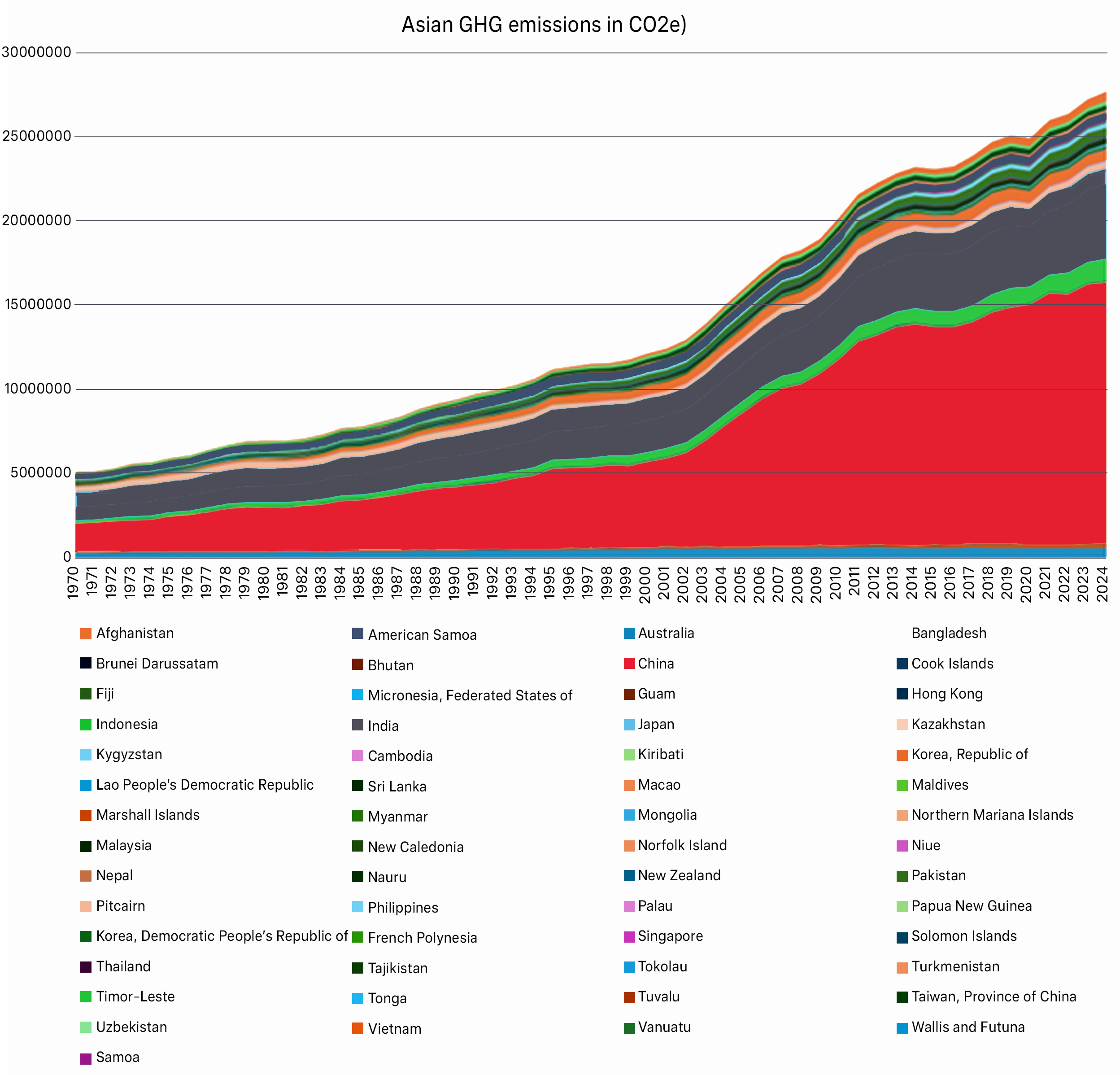
The urgency to address environmental degradation and ensuing financial risks has never been greater in Asia and the Pacific. Just within the last weeks of 2025, millions of people across Southeast Asia were evacuated, with more than 1,000 people dying due to floods. The latest available data for 2024 saw record temperatures in the 175-year observational record, and 2024 was likely the first calendar year to be more than 1.5°C above the pre-industrial era, with 151 unprecedented extreme weather events[i] globally.[ii] The resulting financial losses easily topped previous records, soaring to nearly USD 1.5 trillion globally in 2024 (see Figure 1).[iii] Despite the urgency to mitigate climate risks, emissions across the regions continued to climb (see Figure 1). The economic risk of failing to address climate change in the region is overwhelming, with losses of 11–17 per cent of GDP annually in Asia, rising to 41 per cent by 2100 in a high-emission scenario.[iv]
Figure 1: Global climate-related losses rising from 2000 to 2024 to over USD 1.4 trillion

Yet, while policy action in the region has become increasingly polarised driven by incumbent industries in fossil fuels and active suppression of climate action by the US insistence of selling fossil fuels to the region,[v] the technology driving the green transition has seen continued progress: Globally, renewable energy—much of it manufactured in Asia—outpaced coal as the primary source of energy in the first half of 2025,[vi] while the International Energy Agency (IEA) found that renewable power capacity is expected to double between now and 2030.[vii] Meanwhile, progress is being made in the use of hydrogen for decarbonising industrial processes, including for major emitters like iron and steel.[viii]
The aim of this brief is thus to support decision-makers to better understand current challenges and opportunities in Asia’s green transition. To do so, we analyse four megatrends: first, we look at the increasing challenge and cost of climate adaptation that affects all economies and communities. Second, we look at new opportunities and developments in green technologies, particularly in energy and industrial decarbonisation with a focus on hydrogen and metals. Third, we see that green finance has weathered a US-led pushback of ESG with the highest-ever quarterly green bond issuances in Q3 2025, and significant opportunities have been created through policies. Finally, we analyse how regional collaborative efforts, for example, through ASEAN and BRICS are partly filling a void left by the grinding progress of COP and other international processes.
Figure 2: Asia greenhouse gas (GHG) emissions 1970 to 2024
Climate adaptation: Escalating costs and the humanitarian and financial gap
Asia-Pacific is the “most disaster-prone region in the world”[x] with very diverse consequences across the different economies. Recent assessment warns that climate hazards are already driving higher disaster frequencies, disproportionate human and economic losses, and growing climate-related displacement.[xi] Average annual Gross Domestic Product (GDP) losses in developing Asia-Pacific due to climate hazards could reach $980 billion per year in a worst-case scenario.[xii]
Diverse regional climate vulnerabilities
Regional impacts are geographically distinct and severe, demanding nuanced and specific attention:
- Pacific Islands face existential risks through sea-level rise that occurs at four times the global rate (e.g., 15 cm in Tuvalu and Fiji), compounded by extreme weather.[xiii] This has resulted in irreversible land loss, with climate-related damages exceeding 5 per cent of GDP in Pacific Small Island Developing States. The World Bank explicitly concludes that large-scale relocation will be unavoidable without massive concessional finance with Australia offering pathways for resettlement for the about 10,000 people living in Tuvalu (out of the 2.3 million of the Pacific population).
- South Asia is threatened by high temperatures, resource-related conflicts over water and arable land, and frequent tropical cyclones.[xiv] The sector most affected is agriculture, where over 50 per cent of South Asian women work, facing increasingly strenuous conditions due to heat and erratic rainfall patterns. Pakistan, for example, has suffered multiple intense flood events over the past three years, displacing millions.[xv]
- Southeast Asia must manage extensive coastlines prone to sea-level rises (e.g., Indonesia, Philippines). Altogether, up to 300 million people in the region could be threatened by coastal inundation.[xvi]
Adaptation Finance Gap
Protecting communities and economies from losses requires significant adaptation finance. The estimated adaptation needs for developing countries are acute, projected at USD 310–365 billion per year by 2035.[xvii] Asia and the Pacific require approximately 70 per cent of this global adaptation finance need.
This demand contrasts sharply with the USD 26 billion in international public adaptation finance provided in 2023, meaning current flows are 12–14 times below what is needed (see Figure 3). To put this into context, the required annual adaptation funding is a mere three times the USD 106 billion profits in 2024 of Saudi Aramco, one of the largest fossil fuel producers.[xviii]
A lack of climate adaptation meanwhile creates a self-reinforcing negative economic loop particularly for emerging Asian and Pacific economies: higher disaster losses increase government spending on reconstruction, elevating inflation and sovereign credit risks, which then raise borrowing costs. This forces fiscal consolidation that undermines spending on public services and climate adaptation.[xix]
Figure 3: Adaptation Finance Gap in Asia Pacific
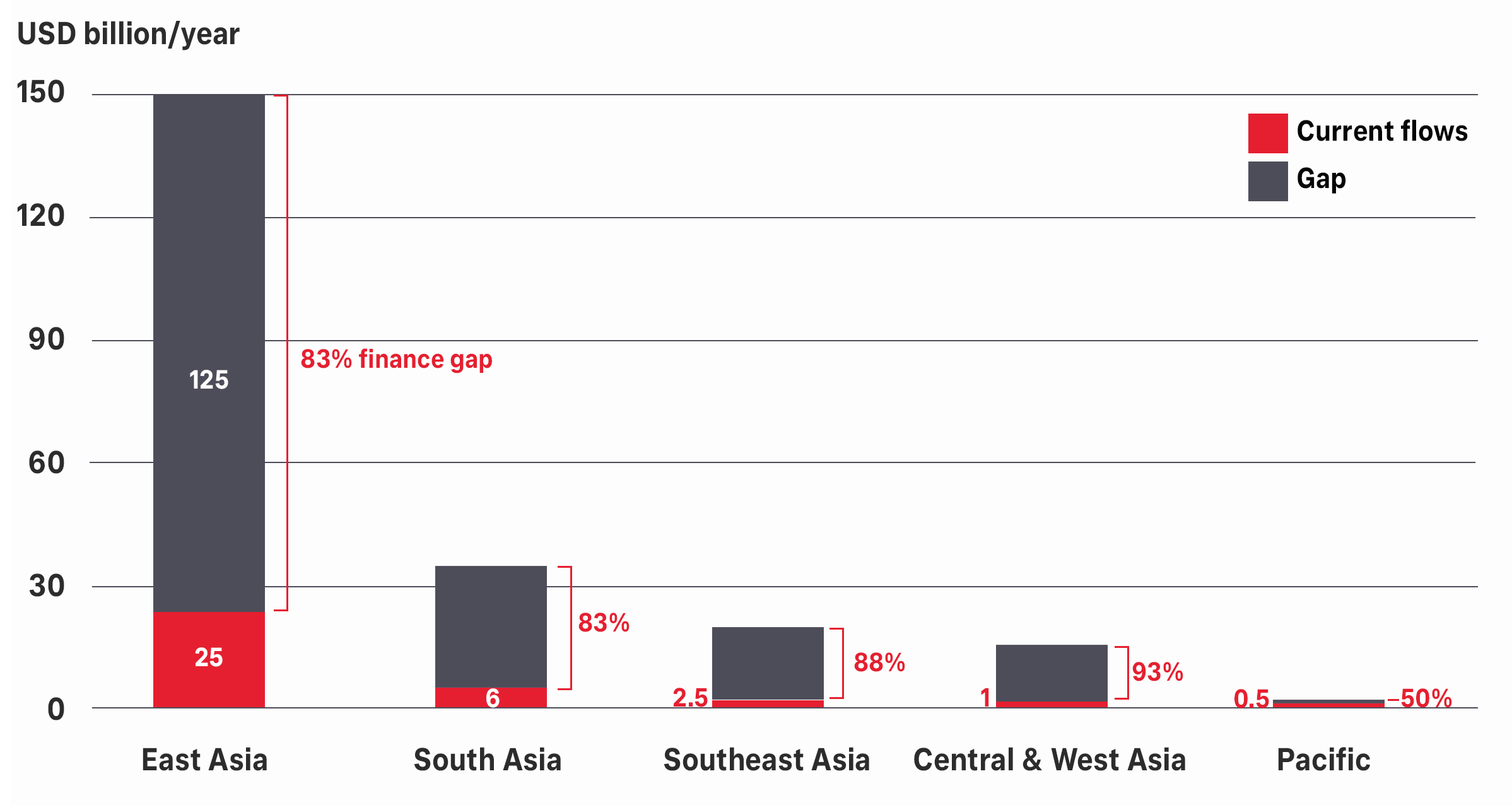
Source: Khanna et al 2025[xx]
Scaling adaptation solutions
In search for climate adaptation solutions, communities are layering three types of responses:
- Grey infrastructure: sea walls, floodgates, upgraded drainage and strategic relocation of critical assets (Jakarta Giant Seawall project).
- Nature-based solutions: mangrove and wetland restoration in Vietnam and Singapore,[xxi] watershed rehabilitation in Nepal, reef and coastal-ecosystem projects in Fiji.
- Indigenous and community-based practices:[xxii] traditional land-use and coastal-protection practices in Melanesia, local water-harvesting systems in rural South Asia, community-managed coastal buffers across several Pacific islands.
Indigenous and community-based practices, in particular, have potential: A recent global study shows that Indigenous peoples manage or influence at least 50 per cent of the world’s remaining biodiversity-rich areas and deliver adaptation outcomes that external programmes often underperform.[xxiii] Scaling such approaches remains severely constrained. Key barriers include:
- Secure land tenure and customary rights: many Indigenous systems operate without formal recognition, limiting their access to climate-finance pipelines.
- Data and measurement gaps: locally led programmes are often excluded from national adaptation tracking mechanisms and metrics aligned with donors.
- Finance modalities oriented to large infrastructure rather than community resilience, meaning projects are small, discrete, and often limited.
- Institutional fragmentation: adaptation planning is often centralised and top-down, while Indigenous practices are bottom-up and distributed—this misalignment blocks integration in national adaptation strategies.
Green technology and industry decarbonisation
Green energy
2025 might have marked an important turning point globally and in various countries of the region, where new green energy installations have not only outpaced fossil fuel energy installations, but renewable energy output has outpaced output from coal plants for the first time in the first half of 2025 (globally).[xxiv] As we report in the China section, emissions in the world’s largest emitter are likely to have peaked in late 2024 due to the rapid scaling of green energy installations. This has led to predictions that global renewable power capacity is expected to double between 2025 and 2030, increasing by 4,600 gigawatts (GW),[xxv] with challenges in grid expansion, supply chain resilience and finance. Another important challenge is politics and international relations, where the US, with support from fossil fuel exporting countries like Qatar, is forcing countries in the region, such as Japan or Indonesia (as well as the European Union) to buy gas worth multiple hundreds of billions of USD in exchange for trade relations with the US and continued security cooperation.[xxvi] A slowdown in the green transition and investment in gas plants is all but certain to increase electricity cost, with negative impacts for economic competitiveness and cost of living, while increasing vulnerabilities to energy sovereignty (i.e., due to the required fossil imports).[xxvii] Considering the rapidly falling cost of battery storage and the rapidly growing use of batteries (i.e., China invested USD26 billion dollars over the past three years to install more than 100 GW of battery storage) to support “firming” of grid (e.g., to ensure electricity is available irrespective of sunshine or wind) makes investment in gas plants and gas infrastructure economically dubious at best.
Batteries
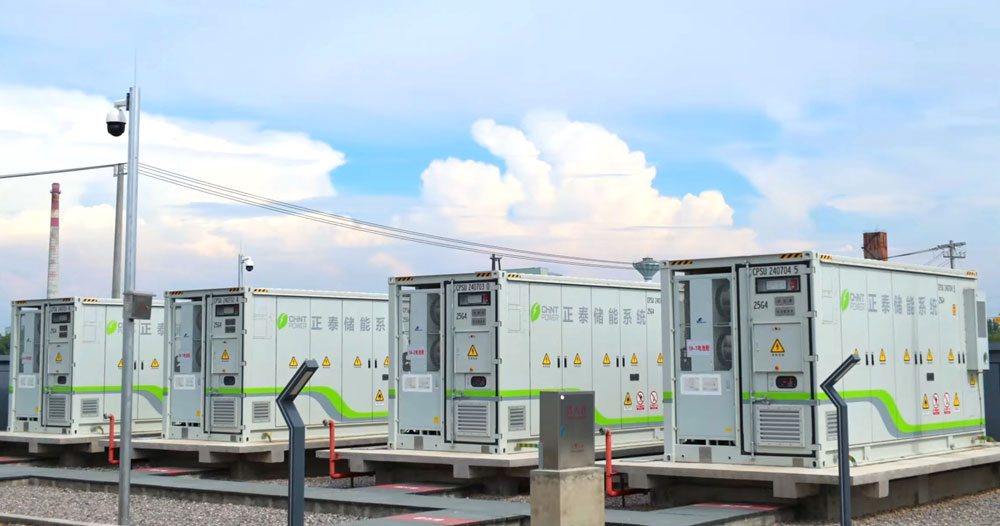
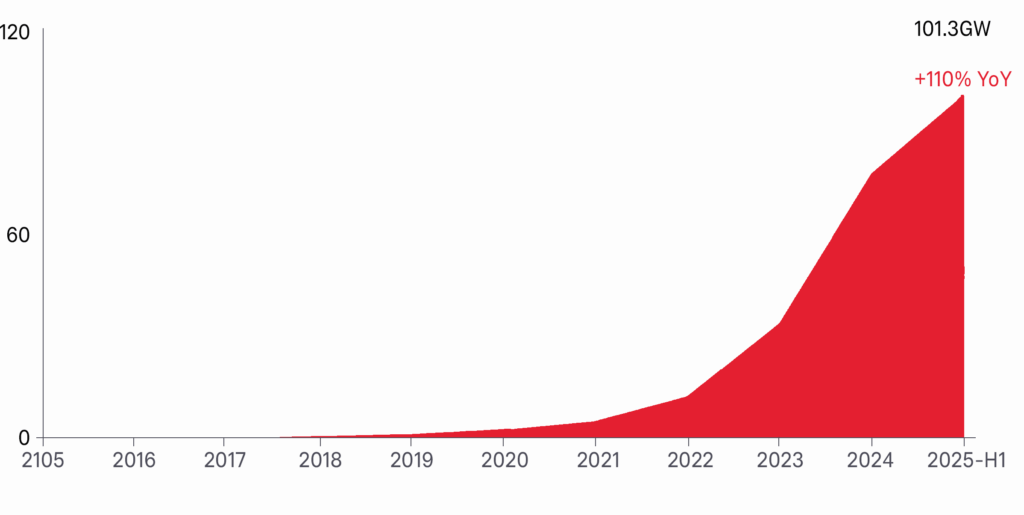
Battery technology development and deployment to improve the integration of intermittent renewable energy sources has been rapidly accelerating in the region, led by China and to a lesser extent Japan: In 2025, China had more than 100 GW of battery storage installed—a 32-fold increase in less than 5 years (see Figure 4). In the first half of 2025 alone, China installed 56.12 GWh of new energy storage.[xxviii] The Asia Pacific stationary flow battery storage market size reached USD 5.9 billion in 2025 and is forecasted to grow by 33.9 per cent through 2034.[xxix]
Figure 4: Battery storage increases 32-fold in China in less than 5 years
Industrial decarbonisation and (green) hydrogen
Industrial decarbonisation remains a challenge, particularly in carbon-intensive industries, such as steel, metals and agriculture. For example, China’s steel sector contributes to 15-17 per cent of China’s emissions.[xxxi] A significant technological leap in Asian metallurgy over the next few years might be the commercial viability of “flash ironmaking” technology. This new process promises a 3,600-fold increase in efficiency compared to conventional blast furnaces, reducing the smelting time from five to six hours down to as little as three seconds. The technology uses a flash smelting method involving injecting finely ground iron ore powder into a high-temperature furnace powered by gas (e.g., hydrogen), achieving near-zero carbon dioxide emissions by eliminating the use of coal. Crucially, this innovation might also enable the more efficient use of China’s abundant domestic low or medium-grade iron ores and, if scaled, reduce China’s need to import higher-grade ores.[xxx
Hydrogen is a central part to the solution. Global green hydrogen capacity deployment and manufacturing are heavily concentrated in China, creating a state of technological hegemony in the supply chain. By mid-2025, global installed water electrolysis capacity surpassed 3 GW. China alone accounts for 65 per cent of global installed capacity and capacity that has reached a Final Investment Decision (FID).Furthermore, China is home to nearly 60 per cent of global electrolyser manufacturing capacity.[xxxiii] In 2025, China launched more than 500 hydrogen projects, and BloombergNEF expects green hydrogen capacity in China to reach 1.2 million tons by 2030. This includes, for example, a USD730 million project in Inner Mongolia to produce about 90,000 tons of green hydrogen annually, while in Hebei, construction of a 1,000-kilometre pipeline started to transport 1.5 million tons a year for steelmaking in Tangshan.[xxxiv]
Japan also expands hydrogen capacity: In March 2025, the Japanese technology company Asahi Kasei received governmental support to expand its domestic manufacturing capacity for key alkaline water electrolyser components, specifically cell frames and membranes and expanded cooperation with Malaysia to develop hydrogen energy technologies.[xxxv] Japan also offered a hydrogen fuel subsidy of 700yen (USD4.84) per kg for H2 fuel cell-powered commercial vehicles to become competitive with diesel.[xxxvi] Several Japanese companies are active in Indonesia to produce green hydrogen and ammonia. Tokyo Electric Power Company (TEPCO) plans to produce hydrogen from geothermal energy.[xxxvii]
The Australian government’s AUD 23 billion “Future Made in Australia” (FMIA) plan, launched in 2024, also targets renewable hydrogen, low-carbon fuels, and critical minerals processing.A cornerstone of this strategy is the focus on green metals, such as the production of low-emissions iron, steel, alumina, and aluminium.[xxxviii]
Green finance
The green investment landscape in Asia is defined by steady private-sector momentum, yet remains structurally hampered by governance and legacy issues.
Stable green finance utilisation
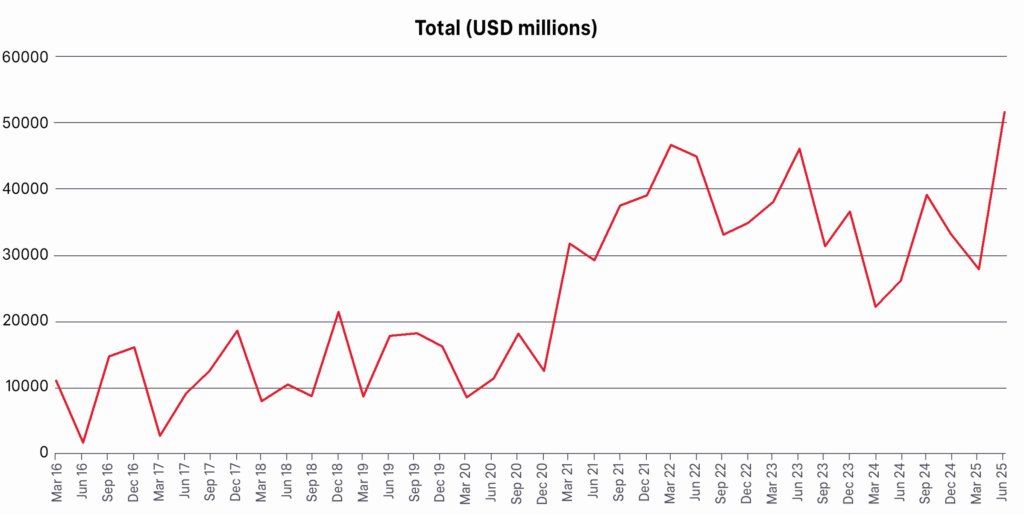
Despite a significant backlash against ESG and the dismantling of the Net Zero Banking Alliance (NZBA) in the West, Asia’s green finance commitments have grown. Issuances of green bonds across Asia hit a record quarter in Q2 2025, with over USD 51 billion raised. Green finance has also driven clean energy investment in the region. In Southeast Asia, for example, investment in green energy totalled $47 billion in 2024, a considerable increase from $30 billion in 2015, achieving near-parity with fossil fuel investment, which decreased to $50 billion. Importantly, this shift is driven by private capital that contributes over 75 per cent of funding for clean power, clean fuels, and battery storage projects in SEA, rising to over 85 per cent in some clean power segments.[xxxix]
Figure 5: Asian green bond issuances 2016 to Q2 2025
Challenges in transition finance for legacy fossil investment
Historically, the region’s rapid economic expansion was fuelled largely by fossil fuels, which accounted for 60 per cent of total energy investment over the past decade. The total installed capacity of coal-fired power in SEA alone reached 121 GW in 2025.[xli] This leads to a substantial structural challenge in transitioning or writing down legacy fossil fuel assets. Assuming a 25-year economic lifespan of the assets, the capital yet to be recovered from these coal plants amounted to more than USD 130 billion in 2025.
Previous international efforts, such as the Just Energy Transition Partnership (JETP) in Indonesia and Vietnam to retire coal plants, are struggling. Meanwhile, Singapore’s TRACTION initiative announced at COP30 that about “one-third of coal plant capacity across 15 Asian markets could be eligible to generate high-integrity credits” and that investors have clear interest in buying carbon credits from early coal retirement.[xlii]
Lack of progress in green finance policy and governance
Regulatory alignment to drive green finance in the region is progressing, but key gaps persist:
- Disclosure: Nearly 70 per cent of 12 Asian financial regulators are planning mandatory climate risk disclosures, aligning with international frameworks like the IFRS standards.42
- Transition Finance: Progress on transition finance taxonomies has been slow (Hayashi 2025), with the first guidance from ASEAN only issued in late 2023.[xliii]
- Central Bank Mandates: Central banks across the region are generally not sufficiently focused on climate mandates, and none have fully implemented capital requirement adjustments for financial institutions to deal with climate risks, with only Singapore, the Philippines, and Malaysia being notable exceptions.[xliv]
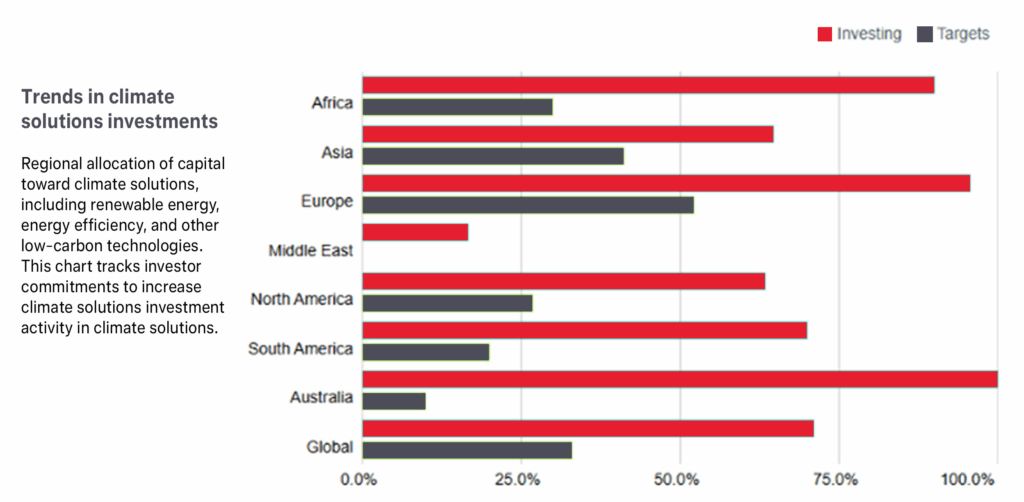
At the same time, Asian investors lag global averages in critical areas, indicating a gap between stated commitments and effective action (see also Figure 6):[xlv]
- Climate Scenario Analysis: Only 58 per cent of regional investors engage, compared to 67 per cent globally.
- Board Oversight: Only 63 per cent of investors assign boards to oversee climate action.
- Climate Solutions Investment: Asian investors rank second to last globally in investing in climate solutions. This is particularly noticeable among Australian investors, where 100 per cent announced a commitment to increase investment, but only 20 per cent invest in climate solutions.
Figure 6: Trends in financial institutions climate target versus investment
International collaboration for green transition: is Asia charting an independent green path?
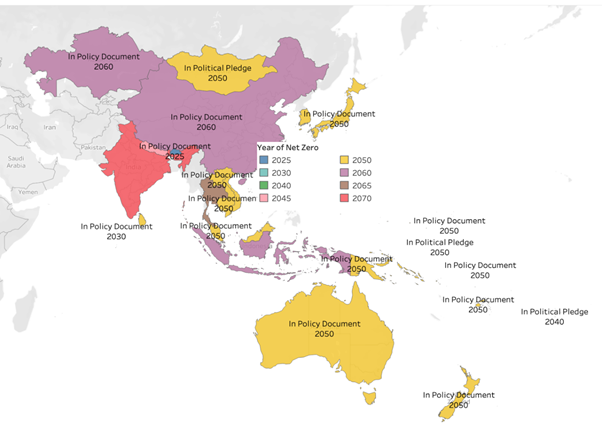
Most Asian economies have strengthened their climate ambitions and have delivered their Nationally Determined Contributions (NDCs) in time for COP30 in November (with the glaring exception of India) (see Figure 7). Yet, while COP30 in November saw insufficient progress for global decarbonisation and finance, regional progress has been made to pursue an “independent green path” in climate governance in Asia (as we also suggested in our last year Green Transition Policy Brief).[xlvii] To that end, various minilateral and multilateral agreements were struck:
Figure 7: Net Zero Ambitions and Policies across Asia and the Pacific
- BRICS: A significant assertion of regional leadership emerged from the BRICS alliance, with Brazil, holding the 2025 Presidency in addition to the COP30 Presidency, effectively took control of the Global South’s climate finance agenda. BRICS demanded the exponential scaling up of adaptation finance, specifically calling for the doubling of 2019 levels by 2025,[xlviii] and has begun setting the structural agenda for the New Collective Quantified Goal (NCQG) for COP 30.[xlix]
- UN’s Fund for Responding to Loss and Damage (FRLD) in the Asia-Pacific, headquartered in the Philippines, started its mission with an initial disbursement goal of US$250 million by mid-2026. This marks a crucial step toward climate justice for the region’s most vulnerable nations.[l]
- ASEAN: the ASEAN-UN Plan of Action for 2026–2030 places a high priority on disaster management. The strategy focuses on strengthening ASEAN’s regional capacity for disaster risk assessment and monitoring. Critically, the plan mandates the integration of Climate Change Adaptation (CCA) and Disaster Risk Reduction (DRR) within the post-2025 ASEAN Community framework, recognising that these elements must be tackled holistically to protect vulnerable rural communities and advance sustainable development goals.[li] It further strengthened its external climate architecture in collaboration with the European Union manifested in the inaugural 1st ASEAN-EU Ministerial Dialogue on Environment and Climate Change.[lii] Also Australia was identified as a key “green regional partner” in a recent ASEAN Climate Change and Energy Project (ACCEPT) report, signalling closer cooperation on sustainable development and transition projects.
- Shanghai Cooperation Organization (SCO):[liii] China’s President Xi Jinping announced that China will invest in building 10 gigawatts (GW) of solar and 10 GW of wind power across SCO member countries over the next five years.[liv] Member states supported the proposal to hold a high-level SCO-LAC (Latin America and the Caribbean) meeting on ”Climate Change and Sustainable Energy“ in Astana on 3 October 2025 and a regional climate summit in the Republic of Kazakhstan in 2026.[lv] It should also be said that Russia had announced the new Siberia 2 pipeline carrying 50 billion cubic meters of gas between Russia and China, which so far had not been confirmed by China.[lvi]
- Pacific Islands Forum (PIF): The establishment and operationalisation of the UN-backed Fund for Responding to Loss and Damage (FRLD) is a direct result of decades of PIF and developing country pressure. The FRLD, significantly, has its headquarters located in the typhoon-battered Philippines, emphasising the regional vulnerability it addresses. The Fund announced it would begin accepting applications starting 15 December 2025, with the strategic goal of disbursing an initial allocation of US$250 million by the end of June 2026.[lvii]
Recommended actions
The Asia-Pacific green transition in 2025–2026 is defined by an escalating physical and financial costs of climate impacts (forecasted annual GDP losses up to 17 per cent in a high-emission scenario) against a backdrop of rapidly accelerating regional technological and diplomatic momentum. While the US-led political volatility attempts to undermine global climate efforts, Asia is increasingly forging an autonomous, multi-aligned green path driven by various Asian and Pacific partners and by increasingly commercially viable green technology options.
China has become the most relevant innovator driving green technologies innovation and deployment. While a recent Bloomberg analysis noted that China’s technological advantage makes venture capital investment in green technology in Europe and the US all but unlikely,[lviii] the appropriate response, however, is not to slow the green transition. Neither should incumbent fossil fuel industries be supported as they have, despite clear and long-term decarbonisation goals, failed to invest sufficiently in their transition and are now trying to convince policymakers to financially prop up struggling operations for reasons like “local jobs” or “national security”.[lix] Examples include Australia’s AUD 600 million bailout of Glencore’s Mt Isa copper smelter and the US push to protect and promote its gas industry, leading to higher energy prices[lx] and greater climate change risk for all.8 Rather Asia Pacific economies and partners need to expand collaboration with Chinese green technology providers where necessary and feasible to benefit from the abundance of green technologies. At the same time, clear regional national strategies to safeguard national interest, diversify innovation, and build supply chain resilience must be developed. This can include the establishment of Asian (e.g., Australia-ASEAN+3) critical mineral-to-battery supply chains, expand integrated green electricity grids (similar to the first cross-border renewable energy project between Vietnam and Laos),[lxi] or the establishment of regional green hydrogen and ammonia supply chains.
Overall, keeping up the green transition momentum across Asia and the Pacific will be important, and we encourage taking the urgent considerations into account:
- Close the Adaptation Finance Gap: Implement mandatory climate resilience criteria for all national and multilateral development bank (MDB) project financing, prioritising local, nature-based adaptation solutions and securing land tenure for vulnerable communities.
- Establish Resilient Green Supply Chains: Form strategic regional alliances (e.g., Australia-ASEAN+3) to diversify critical mineral processing and green technology manufacturing (batteries, hydrogen), balancing cooperation with China’s technological advantage while mitigating supply chain risks.
- Accelerate Decarbonisation Finance: Mandate capital requirement adjustments for climate risks by central banks, accelerate the finalisation and implementation of Transition Finance Taxonomies, and use carbon credit mechanisms (like Singapore’s TRACTION) to finance the early retirement of legacy coal assets.
- Uphold an Independent Green Path: Reject geopolitical or incumbent industry pressure to increase long-term fossil fuel commitments (e.g., natural gas) and rather prioritise national and regional energy sovereignty through accelerated investment in low-cost, high-performance renewable energy and storage.
About the authors

Christoph Nedopil | Griffith Asia Institute
Dr Christoph Nedopil is Director of the Griffith Asia Institute and Professor at Griffith University, Australia. He is also a Visiting Professor at Fudan University and Singapore Management University. Christoph advises governments, financial institutions, and civil society on sustainable development and has authored key publications, including the UNDP SDG Finance Taxonomy. His work appears in leading journals like Science, and he is frequently cited in global media such as the Financial Times and The Economist. He has held roles with the World Bank, GIZ, and top universities in China, and serves on boards promoting sustainability in business and finance.

Fabby Tumiwa | Institute for Essential Services Reform (IESR)
Fabby Tumiwa is Executive Director of the Institute for Essential Services Reform (IESR) and a leading energy transition strategist in Indonesia. A founding member of IESR in 2006, he has over 20 years of experience in energy policy and regulation, with a strong focus on renewable energy and climate change. Fabby advises government agencies, businesses, NGOs, and multilateral organisations on electricity regulation, energy efficiency, and climate policy. He has represented Indonesia in international climate negotiations and served on key national bodies, including the National Council on Climate Change and the Indonesia Climate Change Trust Fund (ICCTF).
[i] “An extreme weather event is rare at a particular place and time of year, with unusual characteristics in terms of magnitude, location, timing, or extent. The characteristics of what is called extreme weather may vary from place to place in an absolute sense.” 2
[ii] Extreme weather. World Meteorological Organization https://wmo.int/topics/extreme-weather (2023); 2024 Extreme Events Dashboard. World Meteorological Organization https://experience.arcgis.com/experience/5cb119c71c6c4f8a89b837bf5cf353b8 (2025); Carrington, D. More than 150 ‘unprecedented’ climate disasters struck world in 2024, says UN. The Guardian (2025).
[iii] Mooney, A. The world is struggling to halt climate change. But can it adapt? Financial Times (2025).
[iv] ADB Says Climate Change Could Reduce GDP in Developing Asia and the Pacific by 17 per cent by 2070. Asian Development Bank (ADB) https://www.adb.org/news/adb-says-climate-change-could-reduce-gdp-developing-asia-and-pacific-17-2070 (2024); UNESCAP. Economic and Social Survey of Asia and the Pacific 2025: Understanding the macroeconomic implications of climate change. https://repository.unescap.org/items/183abd46-91f4-4580-8fe8-ff730e851573 (2025).
[v] Nedopil, C. Trump is pushing allies to buy US gas. It’s bad economics – and a catastrophe for the climate. The Conversation http://theconversation.com/trump-is-pushing-allies-to-buy-us-gas-its-bad-economics-and-a-catastrophe-for-the-climate-266792 (2025) doi:10.64628/AA.ec7ehhgcq.
[vi] Wiatros-Motyka, M. & Rangelova, K. Global Electricity Mid-Year Insights 2025. Ember https://ember-energy.org/latest-insights/global-electricity-mid-year-insights-2025 (2025).
[vii] International Energy Agency (IEA). Renewables 2025. https://iea.blob.core.windows.net/assets/76ad6eac-2aa6-4c55-9a55-b8dc0dba9f9e/Renewables2025.pdf (2025).
[viii] Evans, S. The promise of green iron: can Australia reinvent its biggest export? Mining Technology https://mine.nridigital.com/mine_australia_sep25/the-promise-of-green-iron-can-australia-reinvent-its-biggest-export (2025); Nedopil, C. China’s greening steel industry signals an economic reality check for Australia. The Conversation http://theconversation.com/chinas-greening-steel-industry-signals-an-economic-reality-check-for-australia-261863 (2025).
[ix] European Commission. EDGAR – The Emissions Database for Global Atmospheric Research. (2025).
[x] ` Economic and Social Survey of Asia and the Pacific 2025: Understanding the Macroeconomic Implications of Climate Change. (United Nations Research Institute for Social Development, Bloomfield, 2025).
[xi] Making Our Future: New Directions for Human Development in Asia and the Pacific. https://www.undp.org/asia-pacific/rhdr2024 (2023).
[xii] Economic and Social Survey of Asia and the Pacific 2025: Understanding the Macroeconomic Implications of Climate Change. (United Nations Research Institute for Social Development, Bloomfield, 2025).
[xiii] UNDP & PIFS. Pacific Climate Security Assessment Guide. (2023); NASA Analysis Shows Irreversible Sea Level Rise for Pacific Islands. NASA https://www.nasa.gov/earth/climate-change/nasa-analysis-shows-irreversible-sea-level-rise-for-pacific-islands/ (2024).
[xiv] Barry, S., Whitaker, E., Wevers, D. & Pohl, B. Climate, Peace and Environmental Resilience in the Asia-Pacific Region | Weathering Risk. https://weatheringrisk.org/en/publication/climate-peace-and-environmental-resilience-asia-pacific-region (2025).
[xv] ‘The needs are huge’: Pakistan reels from floods as millions left homeless | UN News. United Nations https://news.un.org/en/story/2025/09/1165864 (2025).
[xvi] “ADB Says Climate Change Could Reduce GDP in Developing Asia and the Pacific by 17% by 2070,” Asian Development Bank (ADB). Accessed: Nov. 18, 2025. [Online]. Available: https://www.adb.org/news/adb-says-climate-change-could-reduce-gdp-developing-asia-and-pacific-17-2070
[xvii] United Nations Environment Assembly of the United Nations Environment Programme (UNEP). Adaptation Gap Report 2025 Running on Empty. The World Is Gearing up for Climate Resilience — without the Money to Get There. https://www.unep.org/resources/adaptation-gap-report-2025 (2025).
[xviii] Aramco announces full year 2024 results. Saudi Aramco https://www.aramco.com/en/news-media/news/2025/aramco-announces-full-year-2024-results (2025).
[xix] UNESCAP, “Economic and Social Survey of Asia and the Pacific 2025: Understanding the macroeconomic implications of climate change.” Accessed: Nov. 14, 2025. [Online]. Available: https://repository.unescap.org/items/183abd46-91f4-4580-8fe8-ff730e851573; Strategies for Climate Resilience and Equity in Developing Asia and the Pacific. (Asian Development Bank Institute (ADBI), Manila, 2025).
[xx] N. Khanna, D. Mitra, S. Chandra Rai, and U. Pal, “Bridging the Adaptation Finance Gap in Asia,” Climate Policy Initiative (CPI), San Francisco, Sept. 2025. Accessed: Nov. 18, 2025. [Online]. Available: https://www.climatepolicyinitiative.org/publication/bridging-
[xxi] “Impacts of Climate Hazards on Major Sea Cities in South East Asia,” Zurich Resilience Solutions, Zurich, 2025. [Online]. Available: https://edge.sitecorecloud.io/zurichinsurf8c0-zwpshared-prod-d824/media/project/zurich-headless/zrs/docs/reports-and-ebooks/climate-hazards—major-sea-cities-in-south-east-asia—report.pdf
[xxii] United Nations Economic and Social Commission for Asia and the Pacific (UNESCAP), Intangible cultural heritage safeguarding and climate action in Asia and the Pacific – UNESCO Digital Library. Paris, 2025. Accessed: Nov. 14, 2025. [Online]. Available: https://unesdoc.unesco.org/ark:/48223/pf0000394981
[xxiii] Global Study on Indigenous Peoples’ Climate Contributions. https://www.climatechampions.net/news/global-study-on-indigenous-peoples-climate-contributions-reaches-a-key-milestone (2025).
[xxiv] M. Wiatros-Motyka and K. Rangelova, “Global Electricity Mid-Year Insights 2025,” Ember. Accessed: Nov. 10, 2025. [Online]. Available: https://ember-energy.org/latest-insights/global-electricity-mid-year-insights-2025
[xxv] International Energy Agency (IEA), “Renewables 2025,” International Energy Agency (IEA), Paris, 2025. [Online]. Available: https://iea.blob.core.windows.net/assets/76ad6eac-2aa6-4c55-9a55-b8dc0dba9f9e/Renewables2025.pdf
[xxvi] C. Nedopil, “Trump is pushing allies to buy US gas. It’s bad economics – and a catastrophe for the climate,” The Conversation. Accessed: Oct. 21, 2025. [Online]. Available: http://theconversation.com/trump-is-pushing-allies-to-buy-us-gas-its-bad-economics-and-a-catastrophe-for-the-climate-266792
[xxvii] P. Simshauser and J. Gilmore, “The Counterfactual Scenario: are renewables cheaper,” Griffith University, Brisbane, 2025–07, June 2025. [Online]. Available: https://www.griffith.edu.au/__data/assets/pdf_file/0022/2174413/No.2025-07-The-Counterfactual-Scenario-v2.pdf
[xxviii] Power storage (measured in GW) is a key component for rapid response of electricity demand or supply fluctuations (e.g., when the wind suddenly stops or a cloud covers the sun). Stored energy (measured in GWh) tells how long energy can flow.
[xxix] Asia Pacific Stationary Flow Battery Storage Market, 2034 Report. https://www.gminsights.com/industry-analysis/asia-pacific-stationary-flow-battery-storage-market (2025).
[xxx] “CNESA Major Release on the 10th Western China Energy Storage Forum,” China Energy Storage Alliance. Accessed: Nov. 20, 2025. [Online]. Available: http://en.cnesa.org/latest-news/2025/8/19/cnesa-major-release-2303gw5612gwh-of-new-energy-storage-added-in-h1-2025-cumulative-installed-capacity-surpasses-100gw-for-the-first-time
[xxxi] C. Nedopil, “China’s greening steel industry signals an economic reality check for Australia,” The Conversation. Accessed: July 31, 2025. [Online]. Available: http://theconversation.com/chinas-greening-steel-industry-signals-an-economic-reality-check-for-australia-261863
[xxxii] “bne IntelliNews – New Chinese iron-making method increases production speed 3,600-fold.” Accessed: Nov. 20, 2025. [Online]. Available: https://www.intellinews.com/new-chinese-iron-making-method-increases-production-speed-3-600-fold-403688/; [31] S. Wang, “‘Flash Ironmaking’ and Beijing’s Lead in Industrial Technologies – Jamestown,” Jamestown. Accessed: Nov. 20, 2025. [Online]. Available: https://jamestown.org/flash-ironmaking-and-beijings-lead-in-industrial-technologies/
[xxxiii] IEA. Global Hydrogen Review 2025. https://www.iea.org/reports/global-hydrogen-review-2025/executive-summary (2025).
[xxxiv] China Ramps Up Green Hydrogen With Support From New 5-Year Plan. Bloomberg.com (2025).
[xxxv] Hydrogen News from Asia (March 2025) – Hidrojen Teknolojileri Derneği. National Hydrogen Association Türkiye https://www.hidrojenteknolojileri.org/en/hydrogen-news-from-asia-march-2025/ (2025).
[xxxvi] Parkes, R. Japan to offer nearly $5/kg towards hydrogen refuelling costs for fuel cell-powered commercial vehicles. hydrogeninsight.com https://www.hydrogeninsight.com/transport/japan-to-offer-nearly-5-kg-towards-hydrogen-refuelling-costs-for-fuel-cell-powered-commercial-vehicles/2-1-1821366 (2025).
[xxxvii] Izumi, K. Japan’s TEPCO to make hydrogen in Indonesia with geothermal power. Nikkei Asia https://asia.nikkei.com/business/energy/japan-s-tepco-to-make-hydrogen-in-indonesia-with-geothermal-power.
[xxxviii] Nedopil, C. & Zhang, J. Future Made in Australia? Evaluating Australia’s 2024 Green Energy Related Policies and Its Potential Impact on Asia. https://research-repository.griffith.edu.au/handle/10072/431091 (2024) doi:10.25904/CETE-QZ51; OECD. Drivers of Green Iron Production: Green Iron Opportunities in Australia. https://www.oecd.org/en/publications/green-iron-opportunities-in-australia_bbd1e2b8-en/full-report/component-6.html (2025).
[xxxix] Hardcastle, D. et al. Southeast Asia Green Economy 2025 Report: Unlocking systems for growth and impact. https://www.edb.gov.sg/en/business-insights/market-and-industry-reports/southeast-asia-green-economy-2025-report-unlocking-systems-for-growth-and-impact.html (2025).
[xl] Asian Development Bank (ADB). Asian Bonds Online – Data Portal. https://asianbondsonline.adb.org/data-portal/ (2025).
[xli] Hardcastle, D. et al. Southeast Asia Green Economy 2025 Report: Unlocking systems for growth and impact. https://www.edb.gov.sg/en/business-insights/market-and-industry-reports/southeast-asia-green-economy-2025-report-unlocking-systems-for-growth-and-impact.html (2025).
[xlii] Menon, R. Opening Remarks by Singapore’s Ambassador for Climate Action at COP30 Singapore Pavilion. Monetary Authority of Singapore (MAS) https://www.nccs.gov.sg/opening-remarks-by-singapore-ambassador-for-climate-action-at-cop30-singapore-pavilion/ (2025).
[xliii] ASEAN Capital Markets Forum (ACMF). ASEAN Transition Finance Guidance V.2. https://www.theacmf.org/initiatives/sustainable-finance/asean-transition-finance-guidance-v2 (2024).
[xliv] Martindale, W., Hu, F., Canas da Costa, L. & Dahl, E. Climate-Related Risks in Financial Regulation and Supervision in APAC: A Policy Landscape Analysis. https://www.unepfi.org/wordpress/wp-content/uploads/2025/06/APAC_Policy-brief_climate-risks-financial-regulation.pdf (2025).
[xlv] International Investor Group on Climate Change (IIGCC). Global State of Investor Climate Action Dashboard. https://theinvestoragenda.org/wp-content/uploads/2025/10/Global-State-of-Investor-Climate-Action-Report-Data-Dashboard-2.pdf (2025).
[xlvi] International Investor Group on Climate Change (IIGCC). Global State of Investor Climate Action Dashboard. https://theinvestoragenda.org/wp-content/uploads/2025/10/Global-State-of-Investor-Climate-Action-Report-Data-Dashboard-2.pdf (2025).
[xlvii] Nedopil, C. et al. Time to Develop an Asia-Pacific Green Development Agenda. https://research-repository.griffith.edu.au/handle/10072/435657 (2025) doi:10.25904/1912/5787; Hansen, A. & Peili, P. After the American Retreat: How Southeast Asia Can Seize Its Climate Future. https://rsis.edu.sg/rsis-publication/rsis/after-the-american-retreat-how-southeast-asia-can-seize-its-climate-future/ (2025).
[xlviii] BRICS leaders champion global effort for fair climate finance in historic Rio Declaration. BRICS Brasil 2025 https://brics.br/en/brics-leaders-champion-global-effort-for-fair-climate-finance-in-historic-rio-declaration (2025).
[xlix] BRICS Countries Develop Shared Position on Climate Finance. IISD SDG Knowledge Hub https://sdg.iisd.org/news/brics-countries-develop-shared-position-on-climate-finance/ (2025).
[l] Ho, S. ‘We want to spend the money’: catastrophe-hit countries can now apply to UN’s US$800 million loss and damage fund. Eco-Business https://www.eco-business.com/news/we-want-to-spend-the-money-catastrophe-hit-countries-can-now-apply-to-uns-us800-million-loss-and-damage-fund/ (2025).
[li] Plan of Action to Implement the Joint Declaration on Comprehensive Partnership between ASEAN and the United Nations (2026-2030). (2025).
[lii] Joint Press Statement on the first ASEAN-EU Ministerial Dialogue on Environment and Climate Change. ASEAN Main Portal https://asean.org/joint-press-statement-on-the-first-asean-eu-ministerial-dialogue-on-environment-and-climate-change/ (2025).
[liii] Cohen, A. Russia’s Dramatic Pivot: Gas Pipeline Signals Subordination To China. Forbes https://www.forbes.com/sites/arielcohen/2025/09/09/russias-dramatic-pivot-gas-pipeline-signals-subordination-to-china/ (2025).
[liv] Lin, Z. Roundtable: How has the SCO summit impacted the global energy landscape? Dialogue Earth https://dialogue.earth/en/energy/roundtable-how-has-the-sco-summit-impacted-the-global-energy-landscape/ (2025).
[lv] Brubaker, T. The SCO Summit: handshake cooperation, climate bifurcation? E3G https://www.e3g.org/news/the-sco-summit-handshake-cooperation-climate-bifurcation/ (2025).
[lvi] Cohen, A. Russia’s Dramatic Pivot: Gas Pipeline Signals Subordination To China. Forbes https://www.forbes.com/sites/arielcohen/2025/09/09/russias-dramatic-pivot-gas-pipeline-signals-subordination-to-china/ (2025).
[lvii] Ho, S. ‘We want to spend the money’: catastrophe-hit countries can now apply to UN’s US$800 million loss and damage fund. Eco-Business https://www.eco-business.com/news/we-want-to-spend-the-money-catastrophe-hit-countries-can-now-apply-to-uns-us800-million-loss-and-damage-fund/ (2025).
[lviii] Marsh, A. China Road Trip Exposes List of Uninvestable Assets in the West. Bloomberg.com (2025).
[lix] Reeve, A. Beware the classic industry policy trap. Grattan Institute https://grattan.edu.au/news/beware-the-classic-industry-policy-trap/ (2025).
[lx] 27. Simshauser, P. & Gilmore, J. The Counterfactual Scenario: Are Renewables Cheaper. https://www.griffith.edu.au/__data/assets/pdf_file/0022/2174413/No.2025-07-The-Counterfactual-Scenario-v2.pdf (2025).
[lxi] Tribdino, R. Laos Wind Farm Begins Power Exports to Vietnam in Regional First. Cleantechnica https://cleantechnica.com/2025/09/07/laos-wind-farm-begins-power-exports-to-vietnam-in-regional-first/ (2025).