Remembering Colin Mackerras: The professor with the kind heart, deep mind and rope belt
KAYE BROADBENT, CATHERINE BURNS, ANNE CULLEN, MAUREEN TODUNTER AND SUE TREVASKES |
Colin Mackerras was an internationally renowned scholar of China. Perhaps that’s how he will always be remembered, given the bounty he now leaves to the world, not just through a mountain of published writings, but also through rivers of personal and professional relationships with family, former students and colleagues, friends and diverse others in China, Australia and beyond.
But to those of us who were Colin’s students at Griffith University, he was much more than that. His passing has inspired enough stories – memories, anecdotes, tales tall, true and terrific – to fill one more book that’s engaging, spirited and informative enough to be published.
We were originally students of Modern Asian Studies (MAS) in the early 1980s, a time we still treasure as Griffith’s heyday. Griffith was young, Colin was young, and we were younger still. We were thirsty to learn and Colin was thirsty to teach well. We did. And he did.
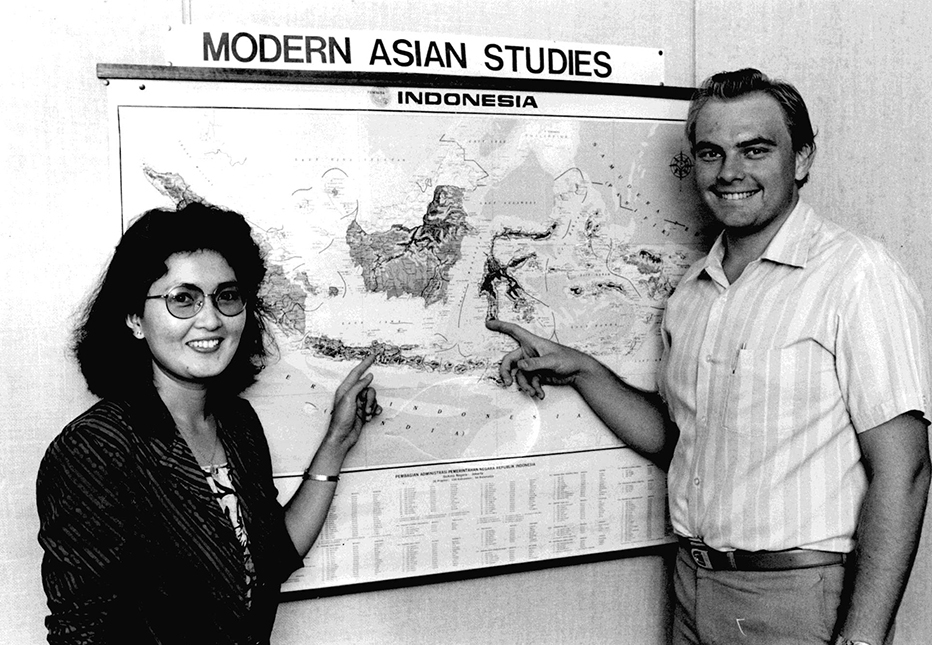
For us, Colin was a great teacher. From him we learned through wide and narrow lenses about Asia. About China and China–Australia relations. About politics, societies, history and histories. About revolution, nationalism, imperialism, Marxism and multiple other isms. Colin’s teaching poured in colour and life. It fuelled our wonder, our questions, our eagerness to understand.
We saw him as distinctive, inquisitive and perceptive. He was quirky. He inspired. He embodied integrity, humility and deep commitment to scholarship, graced with his passion for classical music and theatre. His capacity to galvanise people, ideas and experiences so often worked wonders – for the School, the university and far beyond, as well as for us. He was so very generous with his time, his richly cultivated mind. And with his heart. We were – still are – among the many beneficiaries of it all.
When Asian Studies was at its height at Griffith, Colin was at the heart of it. China was emerging from the Cultural Revolution, a decade of upheaval that ended in 1976. To most Australians, Asia was then a mystery and China profoundly so, as Colin’s teaching and writing about western images of China helped us to unravel. Colin had lived in China during the Cultural Revolution, so his insights were first-hand and illuminating. In his telling, history leapt off the page and into real life. So did the people of China – including those of China’s more than 50 ethnic minorities that Colin explored, wrote and taught about. So too did Chinese drama and Peking opera, which he’d historically surveyed and which continued to live in his heart.
You usually noticed Colin before you heard him. Through the 1980s and well beyond, he dressed in what could have passed as World War II army surplus. His pleated trousers were sometimes held up by a length of rope. Over his collared shirt he often wore a t-shirt bearing a political slogan. We’d wonder whether the t-shirt was a statement, a cover for missing buttons, both or more, but we were too polite to ask him. In hindsight we realise he’d have welcomed our wondering and probably been delighted to answer.
Perhaps most endearing for us then, Colin was not just a deeply learned professor, he was also one of us. He treated students seriously and with respect. Unfailingly. He’d respond with alacrity and insight to our questions, no matter how far from the mark they may have been. Especially so over coffee and biscuits – yes, always crumbly biscuits that would litter the floor – in the Humanities Common Room. Laced with anecdote, these Common Room conversations were some of our richest learning and often inspiration for further enquiry.
Colin cared not just about our learning, but about us. On a snowy winter morning in 1984, he offered to take two Griffith students (including one of us) then studying in Beijing up the Xiangshan Mountain. Halfway up, Colin remarked that it was indeed a rather cold day. Well yes. Snow was tipping into his shoes, and through the holes in his socks. Such was Colin’s will to share his knowledge, expand the experience of his students. And truly, to care for us.
At an Asian Studies conference in Tamworth, a group of shivering postgraduates (again, one of us among them) set off to walk home in the cold. Colin wouldn’t hear of it. He bundled us all into his taxi and delivered us safely to the cheapest pub in town. No wonder the friendships lasted. And maybe no wonder so many of his students followed his path to become academics. We’re among them.
We think everyone who knew Colin would agree: he did not have a malicious bone in his body. His antenna was always tuned to what he could do for others. As his former students, we experienced his deep care for what he taught and the people he taught. We deeply appreciate the privilege of having Colin as one of our teachers in Modern Asian Studies at Griffith.
A few years back we took Colin for a day trip to Springbrook. It was a day well-endowed with memories, laughter, still the same attire for Colin, and surrounded with glorious rainforest. It was a celebration of our friendship and mutual learning, with locally made raspberry jam to polish it off, to Colin’s delight.
Colin, to us and to so many who knew you at Griffith, you’ll always be offbeat and upbeat. Beguiling and beloved.
Thank you, dear teacher and friend.
AUTHORS
Kaye Broadbent, Catherine Burns, Anne Cullen, Maureen Todhunter, Sue Trevaskes are former students of Modern Asian Studies in the early 1980s.