Remembering Colin Mackerras: the making of a China scholar
MICHAEL DUTTON |
Colin Mackerras has, as the Chinese say, gone to meet Marx. For a scholar who first taught me about Chinese Marxism, that will be some meeting. I still recall my own first meeting with him. It began a relationship that would last fifty years, in which my teacher, and later my Doktorvater, became my mentor and friend.
It was 1976, in the subsidised coffee shop at the newly created Griffith University. I had come from Pine Rivers High School, wanting to see and think beyond the monotone world of Brisbane’s northern commuter belt: Greater Brisbane, minus the greatness. Griffith was too far to commute, so I moved south to enrol in its School of Modern Asian Studies (MAS), where Colin was the Foundation Professor. Being part of the second intake and now the second holder of the Colin Mackerras Chair in Australian Studies at Beijing Foreign Studies University, where Colin’s lived experience of socialist China began, seems a strange symmetry.
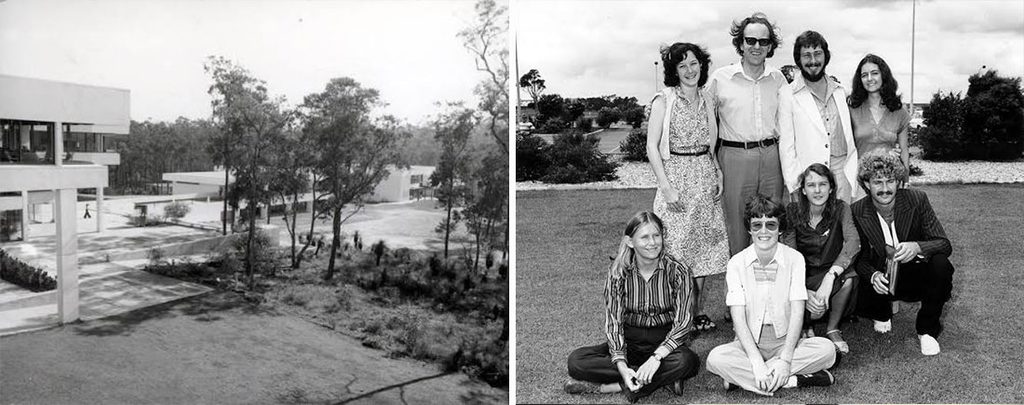
Back then, however, this symmetry was a long way off. I was, to borrow another Chinese phrase, ‘poor and blank’. Like the hundred or so others in MAS and other schools of Griffith, I spent hours drinking coffee and discussing ideas. That cross-pollination would add to our interdisciplinarity, but it was Colin who showed me what it could do. In work that ranged from the Tang dynasty records of the Uyghurs to contemporary Chinese ethnic minorities, from classical Peking Opera to the revolutionary model operas, from Marxism in Asia to Australia–China relations, his approach was nothing if not interdisciplinary. Yet it was an interdisciplinarity focused entirely on China, and as we drank coffee with him we slowly began to imbibe the method. But what I remember most was not his scholarship but that from the very first meeting he knew all our names. That photographic memory, coupled with his encyclopaedic knowledge of all things Chinese, kept us in awe throughout our undergraduate days.
Griffith opened in the afterglow of the Whitlam years but was built in the reactionary era of Bjelke-Petersen’s Queensland. To study things Chinese then felt like an act of defiance. The university felt like a revolutionary base camp, and Colin’s lectures on the Chinese revolution were the spark that would light a prairie fire in me. What struck me was his commitment to giving us an honest appraisal of China as he saw it, in a climate where such honesty was itself a courageous act. His life was filled with many such acts.
Heading off from Cambridge in 1964 to teach English in Beijing, then returning in 1966 as the Cultural Revolution began, was no easy path, because Australia had no diplomatic relations with the People’s Republic and little knowledge of it beyond the ‘Red Peril’. He published what he had seen, and for a generation of scholars brought up on Cold War images, these were not welcome sights. Now, as a new Cold War looms, his assessment of China is again a source of controversy, but Colin held to it to the end, not as a revolutionary or ideologue but as a rigorous scholar weighing the evidence.
I have followed his lead. I learned from him the importance of culture, of interdisciplinarity and of studying China from the ground up and taking its commitment to Marxism-Leninism seriously. His China may not have been mine, but without his, mine would not exist.
I will miss him, and I will continue to draw strength from his courage, erudition, generosity and kindness. He has, quite simply, become the heroic lead in my own model opera.
AUTHOR
Michael Dutton is Professor of Politics in the Department of Political and International Relations, Goldsmiths, University of London and former student of the School of Modern Asian Studies.